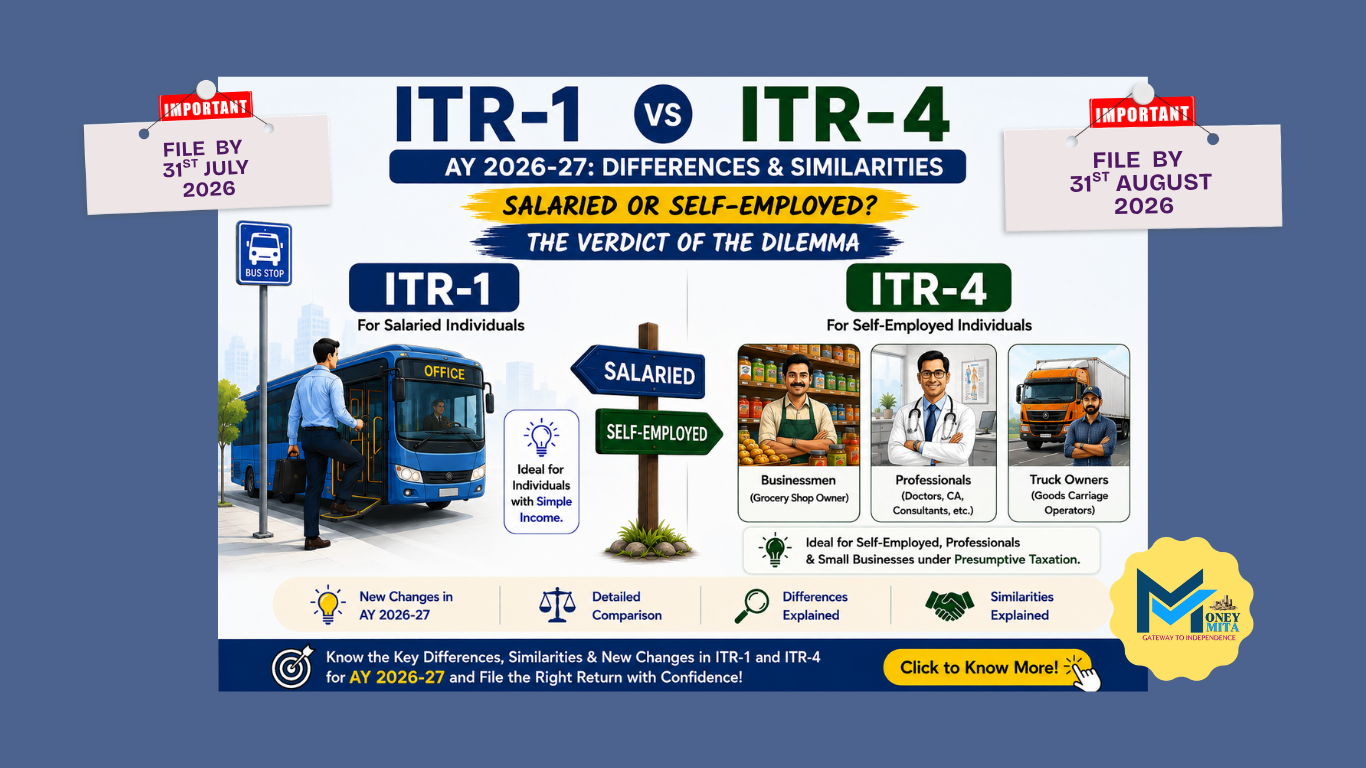
Choosing between ITR-1 and ITR-4 for AY 2026-27 depends mainly on the nature of income, eligibility conditions and the method of income computation.
The key factors include:
- Heads of Income: Whether the taxpayer has income from salary/pension, house property, business/profession or other sources and whether that combination is permitted in ITR-1 or ITR-4.
- Income Computation: Eligible individuals, HUFs and firms may opt for the presumptive taxation scheme, where income is determined on the prescribed presumptive basis rather than through normal computation, subject to the relevant conditions.
- Taxpayer Eligibility: The applicable ITR depends on who the taxpayer is and whether the conditions for filing ITR-1 or ITR-4 are satisfied.
This article explains who can and cannot file ITR-4, the meaning of SAHAJ and SUGAM, the ITR-1 vs ITR-4 AY 2026-27: differences and similarities and how income is disclosed under the presumptive taxation scheme, and the new changes in ITR-1 and ITR-4 for AY 2026-27.
Who can file ITR-4 in AY 2026-27
An eligible assessee carrying on an eligible business or profession can file ITR-4 for FY 2025-26 (AY 2026-27), subject to the prescribed conditions as per the Income Tax Act, 1961.
| ELIGIBLE ASSESSEE | ELIGIBLE BUSINESS/PROFESSION |
|---|---|
| 1. An Individual 2. A Hindu Undivided Family (HUF) 3. A Partnership Firm (other than LLP) who is resident in India in FY 2025-26 and satisfies the prescribed conditions. | 1. Business under section 44AD: Turnover up to ₹2 crore, or ₹3 crore where the prescribed cash-receipt condition is satisfied. 2. Specified profession under section 44ADA: Gross receipts up to ₹50 lakhs, or ₹75 lakhs where the prescribed cash-receipt condition is satisfied. 3. Transport business under section 44AE: Plying, hiring or leasing of up to 10 goods carriages. |
Apart from eligible business or professional income, ITR-4 may also include:
- Salary/pension income.
- Rental Income from up to two house properties.
- Disclosure of Long-term capital gains up to ₹1,25,000/- under Section 112A for reporting purposes only, such as gains from eligible equity-oriented mutual funds, listed equity shares or units of business trusts, subject to prescribed conditions.
- Income from Other Sources, subject to the applicable conditions and restrictions discussed below.
Due Dates of Filing ITR 4
31st August of the assessment year. For AY 2026-27, the due date is 31st August 2026.
Who Can’t File ITR 4 in AY 2026 27
ITR-4 cannot be filed if the taxpayer:
- Is an LLP, AOP, BOI, company or trust.
- Is R-NOR (Resident but Not Ordinarily Resident) or Non-Resident during FY 2025-26.
- Is a Director in a company.
Which Incomes Can’t Be Disclosed Through ITR 4 in AY 2026 27
A. GENERAL CONDITIONS
ITR-4 cannot be used where the taxpayer:
- Has total income exceeding ₹50 lakhs.
- Has deferment of salary income from a foreign retirement account scheme.
- Has income from more than two house properties.
- Has income from any Short-term/ long term capital gains except ₹1.25 lakhs arising from the sale of listed Equity shares/Equity oriented Mutual Funds.
- Has agricultural income exceeding ₹5,000/-.
- Has income from lottery winnings, owning and maintaining race horses, or income taxable under Sections 115BBDA or 115BBE.
B. SPECIAL CONDITIONS
- Commission, brokerage or agency income can’t be reported under the eligible presumptive taxation provisions.
- Business or professional income not eligible for the presumptive taxation scheme cannot be reported through ITR-4.
C. FOREIGN/SPECIAL REPORTING SITUATIONS
- Income arising from a foreign asset or financial interest outside India.
- Income covered by Section 5A requiring special income allocation.
- Holding of shares in an unlisted company at any point during the previous year.
- Tax on ESOPs received from an eligible start-up, where payment of such tax has been deferred.
H2: Why is ITR-4 called “SUGAM”
“SUGAM” means “Easy to Access”.
ITR-4 is designed to simplify tax filing for eligible small business owners and professionals opting for presumptive schemes of taxation to report income.
| WHY IS ITR-4 SIMPLER | HOW DOES IT HELP |
|---|---|
| Presumptive Taxation | Income is “PRESUMED” on a prescribed basis instead of “COMPUTING” actual profit from detailed income and expenses. |
| Simplified Reporting | Fewer financial details are required compared with forms such as ITR-3 and ITR-5. |
| Books Of Accounts | Regular books of account are generally not required when the conditions of the presumptive scheme are satisfied. |
| Tax Audit | Tax audit is generally not required when the applicable presumptive-tax conditions are fulfilled. |
Thus, “SUGAM” reflects the 👉simplified filing and compliance process available to eligible taxpayers doing eligible business.
ITR-1 vs ITR-4 AY 2026-27: Ten (10) Key Differences
| PARTICULARS | ITR-1 | ITR-4 |
|---|---|---|
| 1. Nomenclature | SAHAJ. | SUGAM. |
| 2. Due Date of Filing | 31 July 2026. | 31 August 2026. |
| 3. Filed By | Resident individuals only. | Resident individuals, HUFs and partnership firms only. |
| 4. Types of Income Covered | Specified non-business income. | Eligible business/professional income under presumptive taxation, along with specified non-business income. |
| 5. Predominant income | Salary/Pension. | Business/professional income. |
| 6. Heads of income covered | 4 heads: Salary, House Property, Capital Gains and Other Sources | 5 heads: Salary, House Property, Business/Profession, Capital Gains and Other Sources |
| 7. Is Clubbing of Income allowed? | ❌NO. | ☑️YES. Income of the spouse/minor child can be clubbed, but TDS relating to their income cannot be claimed through ITR-4. |
| 8. Turnover/Gross Receipt limit | ❌Not applicable, as business/professional income cannot be reported. | a) Business u/s 44AD: ₹2 crores, or ₹3 crores subject to the prescribed cash-receipt condition. b) Profession u/s 44ADA: ₹50 lakhs, or ₹75 lakhs subject to the prescribed cash-receipt condition. c)Transport u/s 44AE: Presumptive income based on the prescribed tonnage-vehicle related computation. |
| 9. How is income computed/reported? | Income is computed and reported under the applicable provisions for the four heads of income covered by ITR-1. | Eligible business/professional income is presumed under the relevant presumptive provisions: 6%/8% under 44AD, 50% under 44ADA and the prescribed tonnage-based income computation under 44AE. |
| 10. Can the taxpayer switch between the old and new tax regimes? | ☑️YES. Can switch between regimes every year, subject to applicable conditions | ❌NO. After opting for the old regime, only a one-time switch back to the new regime is permitted |
ITR-1 vs ITR-4 AY 2026-27: Eight (8) Similarities
- Both can be filed only by eligible resident individuals; NRIs cannot file either ITR-1 or ITR-4.
- LLPs, AOPs, BOIs, companies and trusts cannot file either form.
- Income from a maximum of two house properties can be reported.
- LTCG under section 112A up to ₹1,25,000 from eligible listed equity shares, equity-oriented mutual funds or units of business trusts can be reported, subject to applicable conditions.
- Savings/term/recurring-deposit interest, dividend from domestic companies, family pension and agricultural income up to ₹5,000 can be reported.
- House-property loss up to ₹2 lakhs can be set off, subject to applicable conditions.
- Any other Losses other than in SL No. 7, cannot be set off and carried forward through ITR-1 or ITR-4. For that you must file the appropriate ITR, such as ITR-2 or ITR-3.
- Income taxable at special rates, such as lottery winnings or income from owning and maintaining racehorses, cannot be reported through ITR-1 or ITR-4.
How Income Is Disclosed Under the “Presumptive Scheme of Taxation”
Presumptive taxation means estimating income on a presumed basis instead of computing actual business profits/professional income in the usual manner by maintaining books of accounts. Three (3) categories of taxpayers are covered:
- Small traders – Section 44AD.
- Specified professionals – Section 44ADA.
- Transporters – Section 44AE.
| PARTICULARS | 44AD -TRADERS | 44ADA – PROFESSIONALS | 44AE -TRANSPORTERS |
|---|---|---|---|
| 1. Limit For Turnover/Gross Receipts | ₹2 crores, increased to ₹3 crores where cash receipts do not exceed the prescribed 5% of total receipts. | ₹50 lakhs, increased to ₹75 lakhs where cash receipts do not exceed the prescribed 5% of total receipts. | No turnover limit; applicable to eligible goods-carriage operators. |
| 2. Number Of Vehicles owned/leased/hired by transporter | Not Applicable. | Not Applicable. | Maximum 10 goods vehicles or Tractor/Road-Roller. [<=10]. Vehicles can be Heavy or Light depending on the tonnage capacity for goods vehicles and unladen weight for Tractor/Road-Roller. Heavy vehicles: >12 Metric Ton. Light vehicles: <=12 Metric Ton. |
| 3. Presumptive Income for vehicle owned/leased/hired. | 6% of turnover received through banking or digital modes, and 8% of turnover received through cash modes. | 50% of gross receipts. | a) Heavy Vehicles: Tonnage Income System is applied. Minimum Income to be declared as ₹1,000/-per Ton per month. b) Light Vehicles: No Tonnage Income is prescribed. Minimum monthly income per vehicle at a flat rate of ₹7,500/- is to be declared. *** if any vehicle is owned/leased/hired for part of a month, it will be treated as full month for income computation. |
Example – Section 44AE: Suppose a transporter Mr. Pankaj Kumar owns 2 goods vehicles-One for heavy (15MT) and one for light goods (10 MT). Both vehicles were leased for 6 months 10 days in the FY 2025-26. Compute Income of Mr. Pankaj for FY 2025-26 following provisions of section 44AE of the IT Act 1961.
Ans. As both vehicles were leased for 6 months-10 days, so part of the month (10days) is taken for full month- thereby income is to be computed for 7 months.
Heavy goods vehicle: ₹1,000 * 15 * 1 (vehicle) * 7(month)=1,05,000/-.
Light goods vehicle: ₹7,500 * 1(vehicle) * 7(month)=52,500/-.
The Total income of Mr. Pankaj declaring income by presumptive scheme of taxation is ₹1,57,500/- (1,05,000+52,500).
Refer the amendment by CBDT on 44AE income computation, as discussed by TAXGURU in their blog.
ITR-4 AY 2026-27: New Changes
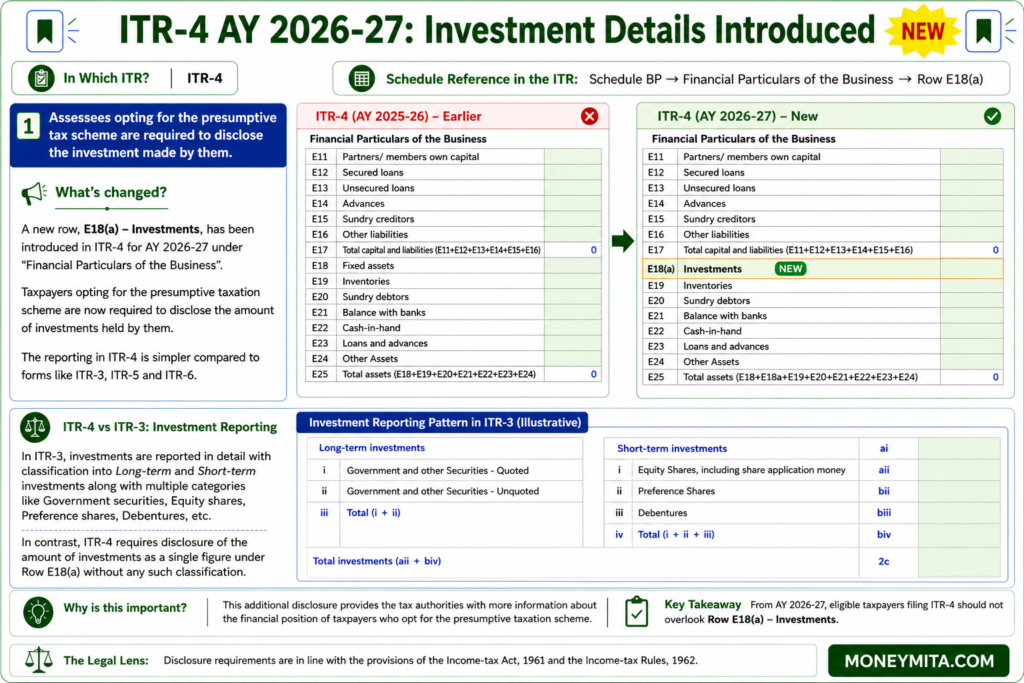
1. “First-Time Disclosure of Investments” for Taxpayers Opting for the Presumptive Tax Scheme:
🔎 In Which ITR: ITR-4
🔎 Schedule Reference in the ITR: Schedule BP 👉 Financial Particulars of the Business 👉 Row E18(a)
What’s changed?
📌A new row, E18(a) – Investments, has been introduced in ITR-4 for AY 2026-27 under “Financial Particulars of the Business.” For FY 2025-26, this newly introduced field is optional.
Investments are assets held to earn income or create wealth rather than for day-to-day business use. Examples include shares, mutual funds, jewellery, gold bars, Government securities, bonds and debentures. Example: A small trader opting for Section 44AD has ₹3 lakh of jewellery appearing in his earlier balance sheet and continues to hold it on 31 March 2026. The ₹3 lakhs may be disclosed under E18(a) – Investments.
| PARTICULARS | ITR-3 | ITR-4 |
|---|---|---|
Investment Reporting | Detailed. | Single consolidated amount. |
| Classification | Detailed under Long-term / Short-term and categories such as securities, equity shares, etc. | No detailed classification. |
| Relevant Field | Balance Sheet-Investment schedule. | E18(a) – Investments. |
📌 Key Takeaway: For AY 2026-27, ITR-4 introduces E18(a) – Investments, but unlike ITR-3, it does not require detailed investment-wise classification.
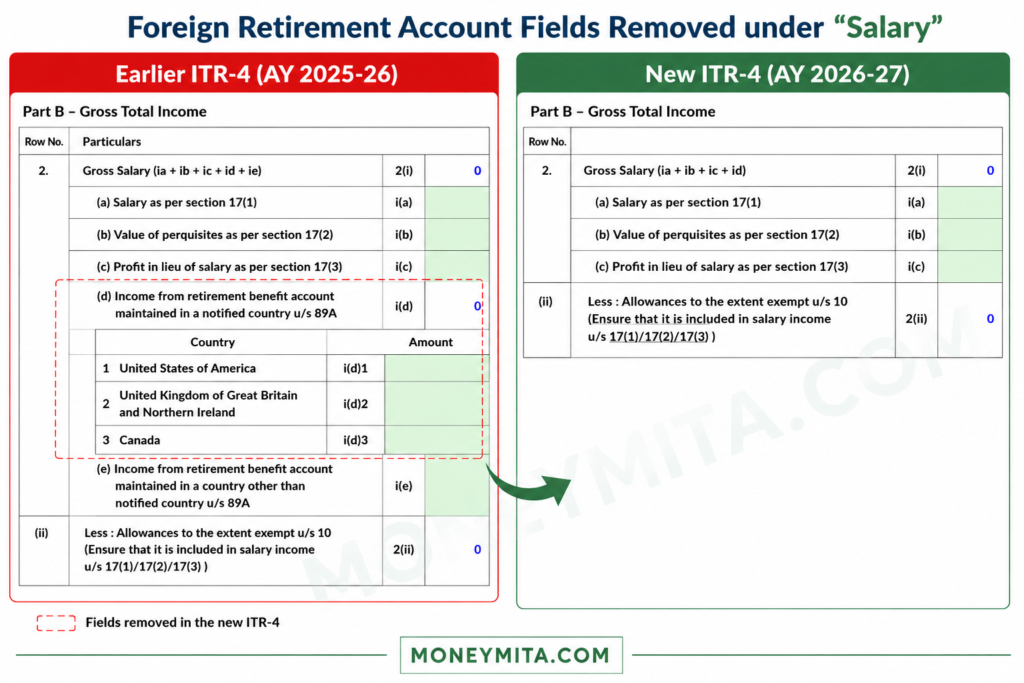
2. Foreign Retirement Account Fields Removed from “Salary”:
🔎 In Which ITR: ITR-1 and ITR-4
🔎 Schedule Reference in the ITR:
- ITR-1 👉 Income Details 👉 Salary / Pension.
- ITR-4 👉 Income Details 👉 Part B – Gross Total Income 👉 Row No. 2.
🔎 Relevant Provision: Section 89A of the Repealed Income-tax Act, 1961 / Section 158 of the Income-tax Act, 2025.
What’s changed?
The earlier fields for income from foreign retirement benefit accounts maintained in notified and non-notified countries have been removed from ITR-1 and ITR-4 for AY 2026-27.
Example:
A resident individual having a foreign retirement account requiring foreign-asset/foreign-income reporting cannot use ITR-1 or ITR-4 and must file the appropriate ITR, such as ITR-2 or ITR-3, as applicable.
📌 Key Takeaway:
The corresponding reporting continues in ITR-2 and ITR-3; the removal is limited to ITR-1 and ITR-4.
Frequently Asked Questions (FAQ)
Q1. Can an individual with business income opt for the old tax regime while filing ITR-4?
Ans. ☑️YES.
An individual having business income can opt for the old tax regime by filing Form 10-IEA on or before 31 August 2026, i.e., within the due date for filing the return under Section 139(1).
Q2. Can an individual with business income switch between the old and new tax regimes every year?
Ans. ❌NO.
An individual having business income cannot freely switch between the two regimes every year. After opting for the old tax regime, the taxpayer has a one-time option to switch back to the new tax regime. Once switched back, the old regime cannot be opted for again.
Q3. Does a taxpayer opting for presumptive scheme of taxation have to pay advance tax?
Ans. ☑️YES, 100% of the advance tax must be paid by 15 March 2026 for FY 2025-26.
READ MORE:
- What Is Advance Tax? Due Dates & Liability.
- ITR 1-7 AY 2026-27: Who Can File & Common Changes.
- Can ITR-1 be filed in AY 2026-27 with Capital Gains?
- ITR-1 vs ITR-2: AY 2026-27 GUIDE.