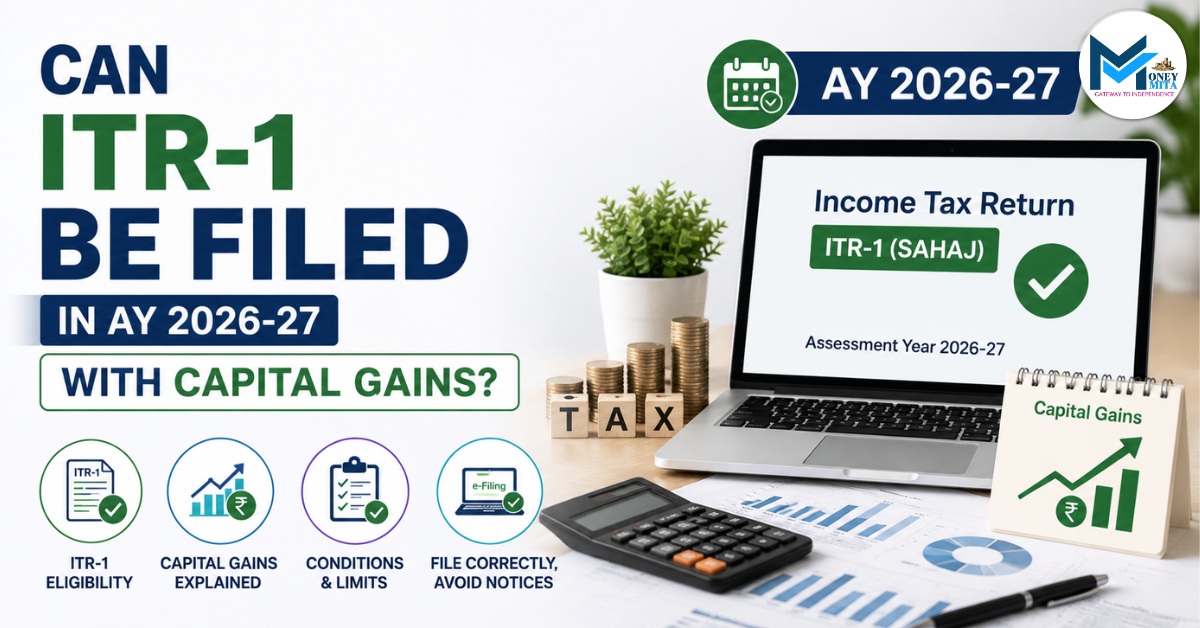
The Income Tax Return (ITR) filing season for Assessment Year (AY) 2026-27 relating to the Financial Year (FY) 2025-26 has begun, and ITR-1 Sahaj continues to be the most commonly used return form for salaried individuals and pensioners. However, one question frequently arises among taxpayers: Can ITR-1 be filed in AY 2026-27 with capital gains?
The answer is yes, but only in limited cases. Under the latest rules, long-term capital gains (LTCG) under Section 112A of the Income Tax Act 1961 arising from the sale of listed equity shares or equity-oriented mutual funds can be reported in ITR-1, provided such gains do not exceed ₹1.25 lakhs and other prescribed conditions are satisfied.
This is an important change because capital gains were traditionally associated with ITR-2. As a result, many taxpayers are now unsure about ITR-1 Sahaj eligibility in the AY 2026-27 and whether their capital gains can be reported in the simplified return form.
In this article, we will explain the rules relating to reporting of Capital Gains in ITR-1 Sahaj, who can file ITR-1, who cannot file ITR-1 in AY 2026-27 with practical examples, which capital gains/ losses cannot be reported in ITR-1 and lastly if choosing tax regimes affect ITR-1 filing.
ITR-1 SAHAJ Eligibility in AY 2026-27 (Who can file?)
An individual can file ITR-1 (Sahaj) for AY 2026-27 if all the prescribed eligibility conditions are satisfied.
➡️Basic Conditions for Filing ITR-1
| PARTICULARS | ELIGIBILITY REQUIREMENT |
| Taxpayer Type | Individual |
| Residential Status | Resident and Ordinarily Resident. (R-OR) |
| Total income | Up to Rupees Fifty Lakhs. (<=₹50,00,000/-) |
👉Which Incomes Are Eligible in ITR-1?
A taxpayer satisfying the basic conditions can report the following income in ITR-1 (Sahaj) for AY 2026-27:
| HEADS OF INCOME | ELIGIBLE INCOME UNDER ITR-1 SAHAJ |
| Salary / Pension | Salary / Pension income. |
| House Property | Income from maximum two (2) house properties with allowance for setting losses up to Rupees Two Lakhs (₹2,00,000/-). |
| Capital Gains | Long-term capital gains under Section 112A of the IT Act 1961 up to ₹1,25,000/- arising from listed equity shares and equity-oriented mutual funds. |
| Other Sources | Savings interest, term deposit and Recurring Deposit interest, dividend income from domestic companies, family pension and agricultural income up to ₹5,000/-. |
The above list covers the income categories that can generally be reported in ITR-1. However, taxpayers should also satisfy all other conditions prescribed for ITR-1 Sahaj eligibility AY 2026-27. If any ineligible income is earned during the year, a different return form may become applicable.
Why is ITR-1 called “SAHAJ”?
“SAHAJ” is a Bengali word meaning “simple” or “easy.” ITR-1 (Sahaj) is designed for taxpayers who have straightforward sources of income such as salary, pension, eligible house property income, limited long-term capital gains under Section 112A of the IT Act 1961 and other simple income sources.
Most of the information required for filing ITR-1 can be gathered from documents such as Form 16, bank statements and information available on the income tax portal. However, taxpayers having business income, foreign assets or complex capital gain transactions generally need to use a more detailed return form. Hence, ITR-1 is known as “Sahaj.”
Who cannot file ITR-1 in AY 2026-27?
Although an individual satisfies the basic eligibility conditions, ITR-1 (Sahaj) cannot be used in certain situations.
Basic Conditions Where ITR-1 Cannot Be Filed:
A person cannot file ITR-1 if:
- He or she is a Resident but Not Ordinarily Resident (R-NOR) during FY 2025-26.
- He or she is a Non-Resident (NR) during FY 2025-26.
- Individuals governed by the Portuguese Civil Code in Goa, the Union Territories of Dadra and Nagar Haveli and Daman and Diu, where income is required to be apportioned between spouses under Section 5A of the Income-tax Act. Although such persons are individuals, they cannot file ITR-1 because the return involves special income allocation provisions.
- The person is not an individual, such as a HUF, firm, LLP, AOP, BOI, company or trust.
Incomes Not Eligible for Reporting in ITR-1:
ITR-1 Sahaj cannot be filed where the total income exceeds Rupees Fifty Lakhs (₹50 lakhs) or where income includes any of the following:
Other Situations Where ITR-1 (Sahaj) Cannot Be Used
Apart from the restrictions discussed above, ITR-1 (Sahaj) cannot be filed ❌ in any of the following situations:
- The taxpayer is a director in any company.
- The taxpayer held unlisted equity shares at any time during the relevant financial year.
- Foreign assets are owned, or a financial interest exists in any foreign entity.
- The taxpayer has signing authority over a bank account located outside India.
- Income is earned, accrued or received from a source outside India.
- Relief of tax under Sections 90, 90A or 91 of the Income-tax Act, 1961 is claimed.
- Tax has been deducted at source under Section 194N of the Income-tax Act, 1961 on cash withdrawals.
- Tax on ESOP perquisites has been deferred under Sections 191(2) or 192(1C) of the Income-tax Act, 1961.
- Income is chargeable to tax under Section 115BBE of the Income-tax Act, 1961.
- A resident author or resident patentee claims deduction under Sections 80QQB or 80RRB of the Income-tax Act, 1961 in respect of eligible royalty income.
- Specified deductions under Part C of Chapter VI-A, including Sections 80-IBA, 80JJA or 80JJAA of the Income-tax Act, 1961, relate to specified business activities, which are outside the scope of ITR-1.
- Exemption under Section 10AA of the Income-tax Act, 1961, is claimed in respect of export profits of an eligible Special Economic Zone (SEZ) unit related to specified business activities, which are outside the scope of ITR-1.
In short, ITR-1 (Sahaj) is designed for taxpayers having straightforward income and minimal disclosure obligations. Where the nature of income or statutory reporting requirements extends beyond its scope, the taxpayer must file the applicable ITR form 2 or 3 or 4.
Practical Examples on ITR-1 Filing
Example 1: a) Mr. A, a Resident and Ordinarily Resident (ROR), has a salary income of ₹6,00,000/- during FY 2025-26. He owns two house properties, one of which is self-occupied while the other is let out at a monthly rent of ₹15,000/-.
b) Mrs. Sima Roy, a Resident and Ordinarily Resident (ROR), owns three house properties. One property is self-occupied, while the other two are let out.
Check ITR-1 filing eligibility in the above two cases.
Ans. a) Yes – Mr. A satisfies the basic conditions for filing ITR-1. His total income is below ₹50 lakhs, consisting of eligible heads, namely salary and income from not more than two house properties.
b) No – ITR-1 permits income from a maximum of two house properties only. Since Mrs Sima Roy owns three house properties, she cannot file ITR-1 and should file ITR-2 instead.
Example 2: Mr. B is a Non-Resident (NR) during FY 2025-26 and has bank interest income of ₹5,00,000/-. Can he file ITR-1?
Ans. No – Although the income is simple and below ₹50 lakhs, ITR-1 is available only to Resident and Ordinarily Resident (ROR) individuals. Therefore, Mr. B must file ITR-2.
Example 3: Mr. Rajesh Sharma has a salary income of ₹12,00,000/- and Long-Term Capital Gain of ₹1,20,000/- from the sale of listed equity shares covered under Section 112A. He has no foreign assets, business income or any other disqualification. Can he file ITR-1?
Ans. Yes – The LTCG is covered under Section 112A and is capped at ₹1.25 lakh. Since all other eligibility conditions are satisfied, Mr. Rajesh Sharma can file ITR-1 (Sahaj) for AY 2026-27.
Example 4: Mr. Akash Patel has Short-Term Capital Gain (STCG) of ₹50,000/- and Long-Term Capital Gain (LTCG) of ₹1,00,000/- from the sale of listed equity shares during FY 2025-26. Can he file ITR-1?
Ans. No – Although the LTCG of ₹1,00,000 is within the permissible limit of ₹1.25 lakh, Mr. Akash Patel also has Short-Term Capital Gain. Since ITR-1 permits only eligible LTCG under Section 112A, he must file ITR-2.
Which Capital Gains/Losses Cannot Be Reported in ITR-1?
While Capital Gains in ITR-1 Sahaj AY 2026-27 are permitted in limited cases, but no allowances for setting off capital losses, taxpayers having the following capital gain/loss transactions generally need to file ITR-2 or another applicable return form:
- Any Short-Term Capital Gain / Loss (STCG/ STCL) arising from the transfer of any short-term capital asset.
- Long-Term Capital Gain / Loss (LTCG/ LTCL) under Section 112A exceeding ₹1.25 lakh from the sale of listed equity shares or equity-oriented mutual funds.
- Any gain or loss short term or long tern arising from the sale of house property, land or other immovable property.
- Any STCG/STCL or LTCG/LTCL arising from the transfer of agricultural land.
- Any STCG/STCL or LTCG/LTCL arising from the transfer of unlisted shares.
- Long-term capital losses requiring set-off against long-term capital gains or capital losses required to be carried forward.
- Capital losses required to be carried forward to subsequent assessment years.
The above list is illustrative and not exhaustive. Taxpayers having complex capital gain transactions generally need to file ITR-2 or another applicable return form instead of ITR-1 (Sahaj).
Does the New Tax Regime or Old Tax Regime Affect ITR-1 Filing?
NO-The choice between the New Tax Regime and the Old Tax Regime does not affect a taxpayer’s eligibility to file ITR-1 (Sahaj).
Eligibility for ITR-1 depends on factors such as:
- Residential Status ☑️
- Total income ☑️
- Nature of income, ☑️ and
- Other prescribed conditions under Rule 12 of the Income-tax Rules 1962 ☑️
The New Tax Regime and the Old Tax Regime are different methods of tax planning available to taxpayers. The choice of tax regime affects tax computation but does not affect eligibility for filing ITR-1 (Sahaj). Therefore, a taxpayer who is otherwise eligible to file ITR-1 can generally opt for either tax regime, subject to the applicable provisions of Section 115BAC of the IT Act 1961.
Tax Regime Declaration in ITR-1:
While filing ITR-1, taxpayers are required to indicate whether they wish to continue under the default New Tax Regime or opt out and be taxed under the Old Tax Regime. This declaration is made in the General Information section of the return form.

As shown above, the return asks:
“Do you wish to exercise the option under Section 115BAC (6) of opting out of the New Tax Regime?” The option under Section 115BAC relates to tax computation and does not determine whether a taxpayer can file ITR-1 (Sahaj).
Selecting:
- “No” means tax will be computed under the New Tax Regime.
- “Yes” means tax will be computed under the Old Tax Regime (subject to applicable provisions).
Therefore, the choice of tax regime and the selection of the ITR form are two separate matters. A person eligible to file ITR-1 can generally choose either tax regime, while a person not eligible for ITR-1 cannot use Sahaj merely because he or she has opted for a particular tax regime.
For ITR-1 SAHAJ E-filing a person need to visit the Income Tax Department – Government of India, E-filing portal.
Frequently Asked Questions (FAQs)
Q1. I made a mistake in choosing the correct ITR. What can happen to me?
Ans. If an incorrect return form is used, the Income Tax Department may treat it as Defective Return and issue a notice under Section 139(9) of the Income Tax Act 1961. The taxpayer is generally required to rectify the defect within the prescribed time. Failure to comply may result in the return being treated as invalid.
Q2. Is it mandatory to declare the nature of employment in the case of salaried individuals and pensioners?
Ans. Yes – The nature of employment must be disclosed in ITR-1 under Part A – General Information.
The taxpayer is required to select the appropriate category from the following options:
- Central Government.
- State Government.
- Public Sector Undertaking (PSU).
- Pensioners – Central Government.
- Pensioners – State Government.
- Pensioners – Public Sector Undertaking (PSU).
- Pensioners – Others.
- Others (Private Sector).
- Not Applicable (Family Pension).
Q3. What does Section 115BBE of the IT Act 1961 deal with?
Ans. Section 115BBE deals with taxation of certain unexplained incomes such as unexplained cash, investments, money, expenditure or other assets referred to in Sections 68 to 69D of the Income-tax Act 1961. Since such income is subject to special tax provisions, taxpayers having income taxable under Section 115BBE cannot file ITR-1 (Sahaj).
Conclusion
Therefore, Capital Gains in ITR-1 Sahaj AY 2026-27 can be reported only in limited situations involving eligible LTCG under Section 112A up to ₹1.25 lakhs.
Continue Reading:
To know more about ITR-2, please visit the blog post “ITR-1 Vs ITR-2: AY 2026-27 GUIDE”