
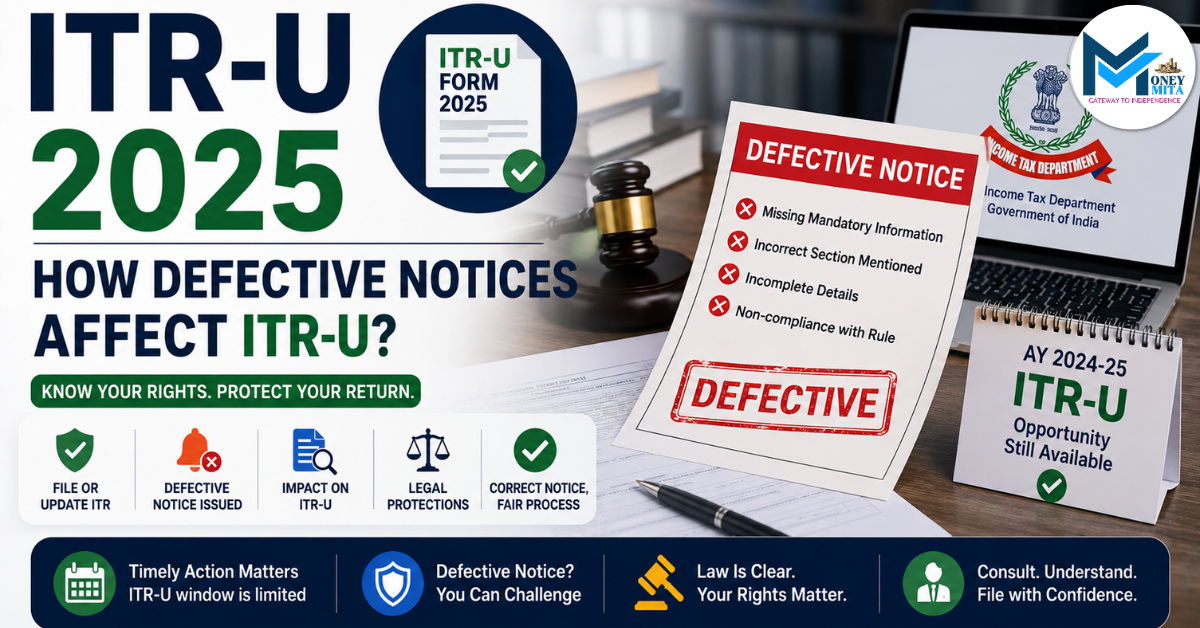
India’s income tax system is rapidly moving toward greater transparency and stricter digital compliance. With PAN–Aadhaar linkage, GST integration, and AI-driven scrutiny, even minor discrepancies in reported income are quickly identified. To help taxpayers voluntarily fix past mistakes, the government introduced the Updated Return (ITR-U) under Section 139(8A). This facility plays an important role in understanding the relation between defective notice and ITR-U, especially in cases involving a defective return u/s 139(9).
In this blog, we will explore the benefits of filing ITR-U, common mistakes to avoid, how to give a proper response to defective return notice, whether ITR-U can be used to switch tax regimes, and how defective notices affect ITR-U filings. We’ll also cover real-life scenarios, highlight the new Tax Year system starting in 2026, and answer practical FAQs to help you stay compliant.
Benefits of ITR-U Filing and Mistakes to Avoid
- Avoids penalty notices for under-reporting.
- Reduces the risk of scrutiny.
- Maintains a clean compliance record.
- Provides peace of mind.
Common Mistakes to Avoid While Filing ITR-U
- Filing without paying additional tax.
- Trying to claim a refund (not allowed).
- Missing the 48-month deadline.
Relation Between Defective Notice and ITR-U
A defective notice is issued when the Income Tax Department finds errors, missing details, or mismatches in the ITR you have already filed.
An ITR-U (Updated Return) is a tool for voluntarily fixing past returns by declaring omitted income or mistakes. However, it does not replace the defective return process.
- If your return is marked defective u/s 139(9), you must correct it first by re-filing or submitting a response.
- If later you realize that you under-reported income or missed certain income, you can use ITR-U to fix it (within 12–48 months).
👉 In short:
- Defective Notice = Department points out errors (reactive).
- ITR-U = You correct past mistakes voluntarily (proactive).
Both aim at compliance, but they work differently.
What is a Defective Return (Notice) Under Section 139(9)?
A notice under Section 139(9) is raised when the ITR you filed has gaps, mistakes, or inconsistencies.
👉 The Income Tax Department won’t correct it on your behalf because:
- Only the taxpayer knows accurate figures (income, deductions, challan details, etc.)
- Legally, the taxpayer is responsible for filing a correct return.
- System auto-checks at CPC only validate; they don’t “fix” your return.
What makes a Return Defective?
Some common reasons are:-
- Wrong ITR form – Choosing an ITR form that does not support the income to be shown there.
- Mismatch with TDS/TCS data – Claiming TDS but TDS not appearing in Form 26AS.
- Business income errors – In disclosing “Income from profits and gains from business/profession”, the Balance Sheet/Profit & Loss statement is not filled out, where the maintenance of books and accounts is mandatory.
- Non-filing of Audit Report – When a tax audit under Section 44AB is required but the audit report has not been submitted.
- Missing schedules or details – Incorrect insurance policy number in 80D claim, missing annexures, or incomplete heads of income.
- Deliberate or accidental omission – Hiding income may pass initial filing but gets flagged when matched against AIS, GST, or TDS data.
Examples of Defective Returns
- A partner in a firm files ITR-1 for his salary from the firm under the heading “Income from salary” instead of filing ITR-3 as “Income from profits and gains from business/profession”. → defective.
- A taxpayer claims TDS credit of ₹10,000/- on interest income but fails to report ₹1,00,000/- interest on deposit under the head ”Income from other sources” or underreports ₹50,000/-. → defective.
How will a Taxpayer be informed about a Defective Return?
- The Income Tax Department communicates a notice under Section 139(9) through your registered email or by post.
- It will also be available on the E-filing portal → Login → Pending Actions → E-Proceedings.
Response To Defective Return Notice
- An assessee generally gets 15 days from the notice date (or longer if extended) to correct it.
- You can authorize another person (e.g., CA) to respond on your behalf.
- The defect can be fixed by filing the Income Tax Return again online with the correct information.
What if You Don’t Respond?
- The return can be considered invalid, meaning it will be treated as if it was never filed.
- This leads to loss of carry-forward of losses, loss of exemptions, penalty, and interest exposure.
Can You File a Fresh Return After Defective Notice?
- If the due date for that assessment year has not expired, you can submit a fresh or revised return.
- When the return filing deadline has passed, the taxpayer must address the notice under Section 139(9) instead of filing a fresh return.
- Failure to respond will result in your return being treated as not filed for that year.
Can I Update My ITR in ITR-U to Switch Between Old and New Tax Regimes?
The short answer: No.
For Individuals without Business Income (ITR-1 & ITR-2)
- You can change it each year, but only until the original filing due date under Section 139(1).
- After that, regime selection is locked.
For Taxpayers with Business/Professional Income (ITR-3 & ITR-4)
- One-time option to switch, but must be exercised before the due date.
- Once chosen, the option generally stays fixed.
✅ In short: ITR-U cannot be used to change tax regimes.
Practical Scenarios Where ITR-U is a Lifesaver
| PRACTICAL SCENARIOS | HOW ITR-U FILING HELPS |
| 1. Salaried Employee | Forgot to report freelance income → disclose via ITR-U and avoid scrutiny. |
| 2. Small Retailer | Underreported turnover → correct before GST mismatch is flagged. |
| 3. Investor | Missed bank interest income → fix proactively with ITR-U. |
| 4. NRI | Missed filing rental income → filed late using ITR-U. |
The New Income-Tax Bill and the “Tax Year” Shift
From April 2026, India will adopt a Tax Year system replacing “Previous Year” and “Assessment Year.”
Why This Matters for ITR-U?
- Cleaner timelines: 48-month window counted from the end of the Tax Year.
- Global alignment: Matches international practice, helps NRIs/MNCs.
- No confusion: Filing years become simpler to track.
Frequently Asked Questions (FAQ)
Q1. I submitted an ITR-U and later got a defective notice.. How do I respond?
Ans. Login to the E-filing Portal → Pending Actions → e-Proceedings → Select Notice → Submit Response.
Q2. While preparing a response, which section should I select?
Ans. For ITR-U → Select 139(8A), and For other returns → Select 139(9).
Q3. Can I submit multiple responses to the same defective notice?
Ans. No, only one response per notice is allowed.
Q4. Is e-verification required for ITR-U?
Ans. Yes. Aadhaar OTP, EVC, or DSC is mandatory for completion.
Q5. Do I need to attach proofs with ITR-U?
Ans. No attachments are uploaded. Keep records ready for future queries.
Q6. I submitted an Updated Return (ITR-U) under Section 139(8A).. Later, I also responded to a defective notice for my earlier return. Which return will be considered as the latest?
Ans. The Updated Return (ITR-U) will prevail. It will be treated as your latest valid return, even if a defective notice response was filed for an earlier return.
Final Thoughts
ITR-U is more than a compliance tool—it’s a chance for taxpayers to correct mistakes before facing penalties. With the Tax Year reform in 2026, timelines will be simpler, but enforcement will be stricter.
The government’s message is clear:
- Opportunity: Fix mistakes voluntarily.
- Accountability: The later you correct, the higher the cost.
- Transparency: Digital trails make it harder to hide.
👉 Voluntary compliance today is always cheaper than enforced compliance tomorrow.
New to updated returns? Start with our ITR-U Basics 2025:UPDATE OLD TAX RETURNS guide to understand eligibility, timelines, and filing rules.