
Selecting the appropriate Income Tax Return (ITR) form is essential for filing your tax return correctly . The ITR 1-7 AY 2026-27 forms have been notified with several updates. While some changes are specific to individual ITR forms, others are common across multiple forms and affect a wide range of taxpayers.
This guide explains who can file which ITR, provides an overview of ITR eligibility for AY 2026-27, and highlights the common changes in ITR forms applicable to Assessment Year (AY) 2026-27. Whether you are an individual, HUF, partnership firm, LLP, company or trust, understanding the correct ITR forms for AY 2026-27 will help you choose the appropriate return form and avoid filing errors.
ITR 1-7 AY 2026-27: Who Can File?
Selecting the correct Income Tax Return (ITR) form is essential for accurate tax filing. The applicable ITR form depends on the taxpayer’s status, nature of income, residential status and eligibility prescribed under the Income-tax Rules. Filing an incorrect ITR may result in a defective return, delayed processing, or the need to file a revised return.
The following tables provide a quick overview of who can file which ITR form for AY 2026-27.
ITR Forms for Individuals and Hindu Undivided Families (HUF)
These ITR forms apply to individuals and HUFs based on their residential status, income and eligibility conditions.
| TAXPAYER | APPICABLE ITR FORM(S) | GENERAL DUE DATE (AY 2026-27) |
|---|---|---|
| 1. Individual – 👤 | ITR-1 (SAHAJ), ITR-2, ITR-3 and ITR-4 (SUGAM). | 31 July / 31 Aug / 31 Oct*** |
| 2. Hindu Undivided Family-👨👩👧👦 | ITR-2, ITR-3 and ITR-4 (SUGAM). | 31 July / 31 Aug / 31 Oct*** |
***💡 Subject to the nature of income and applicable audit requirements.
READ MORE
- Can ITR-1 Be Filed In AY 2026-27 With Capital Gains?
- ITR-1 vs ITR-2: AY 2026-27 GUIDE
ITR Forms for Firms and Other Non-Corporate Entities
These ITR forms apply to firms and other non-corporate entities carrying on business or profession in India or abroad. The applicable filing deadline varies depending on tax audit requirements and other eligibility criteria.
| TAXPAYER | APPICABLE ITR FORM(S) | GENERAL DUE DATE (AY 2026-27) |
|---|---|---|
| 1. Partnership Firm | ITR-4/ ITR-5 | 31 Aug / 31 Oct***. |
| 2. Limited Liability Partnership (LLP) | ITR-5 | Same as above. |
| 3. Association of Persons (AOP) OR Body of individuals (BOI) | Same as above. | Same as above. |
| 4. Artificial Juridical Person (AJP) | Same as above. | Same as above. |
| 5. Local Authority (LA) | Same as above. | Same as above. |
| 6. Representative Assessee (RA) | Same as above. | Same as above. |
| 7. Societies a) Co-operative Bank, b) Co-operative Society, c) Societies registered under Societies Registration Act 1860 | Same as above. | Same as above. |
| 8. Trusts a) Trusts other than those required to file ITR – 7. b) Business Trust. c)Investment Fund. | Same as above. | Same as above. |
| 9. Legal Representative a) Estate of a deceased person. b) Estate of an insolvent person. | Same as above. | Same as above. |
***💡 The due date depends on the nature of income & the tax audit requirement.
ITR Forms for Companies
These ITR forms apply to companies based on their legal status and eligibility. Companies that are eligible for exemption under Section 11 of the Income-tax Act, 1961 are required to file ITR-7, while other companies generally file ITR-6. The filing deadline is determined by the relevant provisions of the Income-tax Act.
| TAXPAYER | APPICABLE ITR FORM(S) | GENERAL DUE DATE (AY 2026-27) |
|---|---|---|
| 1. Indian Company. | ITR-6. | 31 October. |
| 2.Body corporate incorporated outside India. Same as above. | Same as above. | Same as above. |
| 3. Institution, association or body declared as a company under the Income-tax Act. | Same as above. | Same as above. |
| 4. Companies other than those claiming exemption under section 11 of the Income-tax Act, 1961. | ITR-7. | Same as above. |
ITR Forms for Charitable Institutions, Political Parties and Other Specified
Persons
These ITR forms apply to charitable and religious trusts, political parties, research associations, educational institutions and other specified persons required to furnish returns under sections 139(4A), 139(4B), 139(4C) or 139(4D) of the Income-tax Act, 1961.
| TAXPAYER | APPICABLE ITR FORM(S) | GENERAL DUE DATE (AY 2026-27) |
|---|---|---|
| 1. Charitable or Religious Trust [Section 139(4A)] | ITR-7. | 31 October. |
| 2. Chief Executive Officer of Every Political Party [Section 139(4B)] | Same as above. | Same as above. |
| 3. Research Associations, News Agencies and Other Specified Institutions [Section 139(4C)] | Same as above. | Same as above. |
| 4. Universities, Colleges and Other Institutions [Section 139(4D)] | Same as above. | Same as above. |
| 5.Companies that are eligible for exemption under Section 11 of the Income-tax Act, 1961. | Same as above. | Same as above. |
ITR Forms For Assessees Covered Under Transfer Pricing
| TAXPAYER | APPICABLE ITR FORM(S) | GENERAL DUE DATE (AY 2026-27) |
|---|---|---|
| Any assessee required to furnish a report under section 92E of the Income-tax Act, 1961 (Transfer Pricing). | ITR-3, ITR-5, ITR-6 or ITR-7, as applicable, along with Form 3CEB duly certified by a practicing Chartered Accountant. | 30 November. |
Want Smooth ITR Filing in AY 2026-27? 👉 Follow IncomeTaxIndiaOfficial Video
ITR 1 to 7 AY 2026-27:New Changes In ITR Forms
1. Communication Details Expanded in ITR Forms:
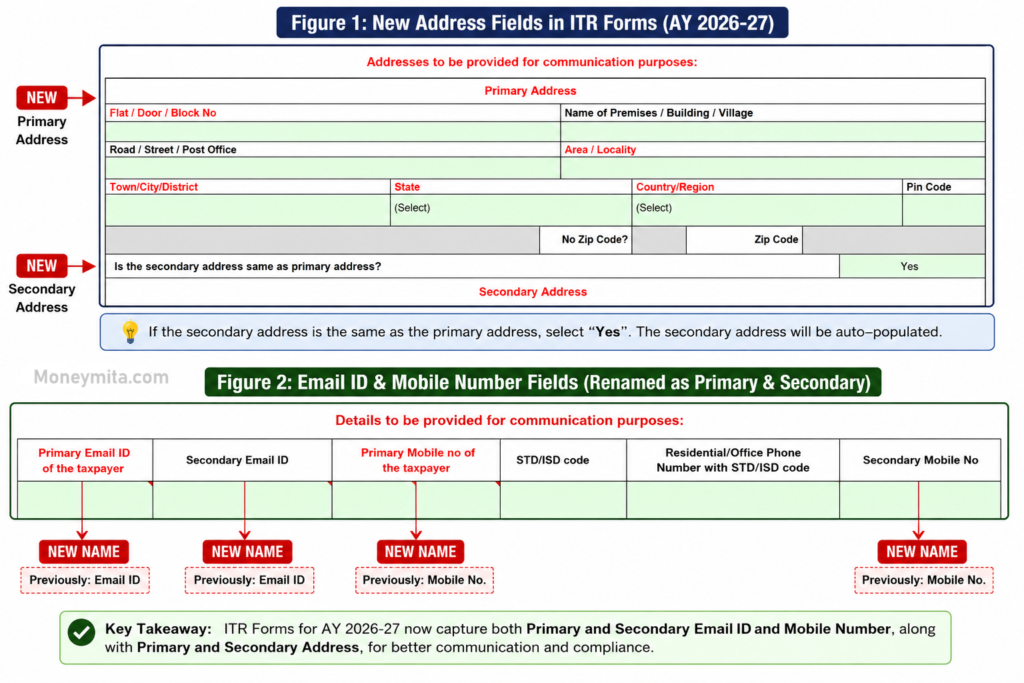
The Income-tax Return (ITR) forms AY 2026-27 have expanded the communication details required from taxpayers. Earlier, only one address was required. The revised ITR forms now provide separate fields for Primary Address and Secondary Address.
The existing fields for two mobile numbers and two e-mail IDs have also been redesignated as Primary Mobile Number/Primary E-mail ID and Secondary Mobile Number/Secondary E-mail ID, respectively. While the number of contact details remains unchanged, their nomenclature has been standardised for better identification and communication.
An Additional address Field is Introduced (initiated)
🔎In Which ITR: ITR 1 to 7.
🔎Schedule Reference in the ITR: Part A – General (Information) – The Personal Information section of the ITR form contains basic particulars of the assessee, including:
- Name, PAN and AADHAAR.
- Status of the assessee like (Individual, HUF, Firm, LLP, Company, Trust, etc.)
- Residential Status (Resident, R-OR, R-NOR or NR).
- Address for communication.
- Birth Date / Date of Incorporation or Formation.
- Tax regime option (Old/New).
- Nature of return (Original, Belated, Revised, Updated or in response to a notice/order).
- Details of the Representative Assessee, wherever applicable.
- Applicability of the seventh proviso to section 139(1) of the IT Act 1961, wherever applicable.
- Portuguese Civil Code details, where applicable.
What’s changed?
The significant amendment in this section relates to the “Details to be Provided for Communication”. The comparison below summarises the changes introduced for AY 2026-27.
| PARTICULARS | AY 2025-2026 (OLD) | AY 2026-2027 (NEW) |
|---|---|---|
| Address of the taxpayer | One address was required. | Two address fields have been introduced – Primary Address and Secondary Address. If both addresses are the same, the Secondary Address is auto populated by selecting the relevant checkbox. Otherwise, the Secondary Address must be entered separately. |
| E-Mail ID | Two E-mail IDs were required as E-mail ID 1 and E-mail ID 2. | The number of E-mail IDs remains unchanged. However, they have been redesignated as Primary E-mail ID and Secondary E-mail ID. |
| Mobile NUMBER | Two mobile numbers were required as Mobile Number 1 and Mobile Number 2. | The number of mobile numbers remains unchanged. However, they have been redesignated as Primary Mobile Number and Secondary Mobile Number. |
2. Revised Return: Extended Time & New Fee ⭐
🔎 In Which ITR: ITR 1 to 7.
🔎Schedule Reference in the ITR:
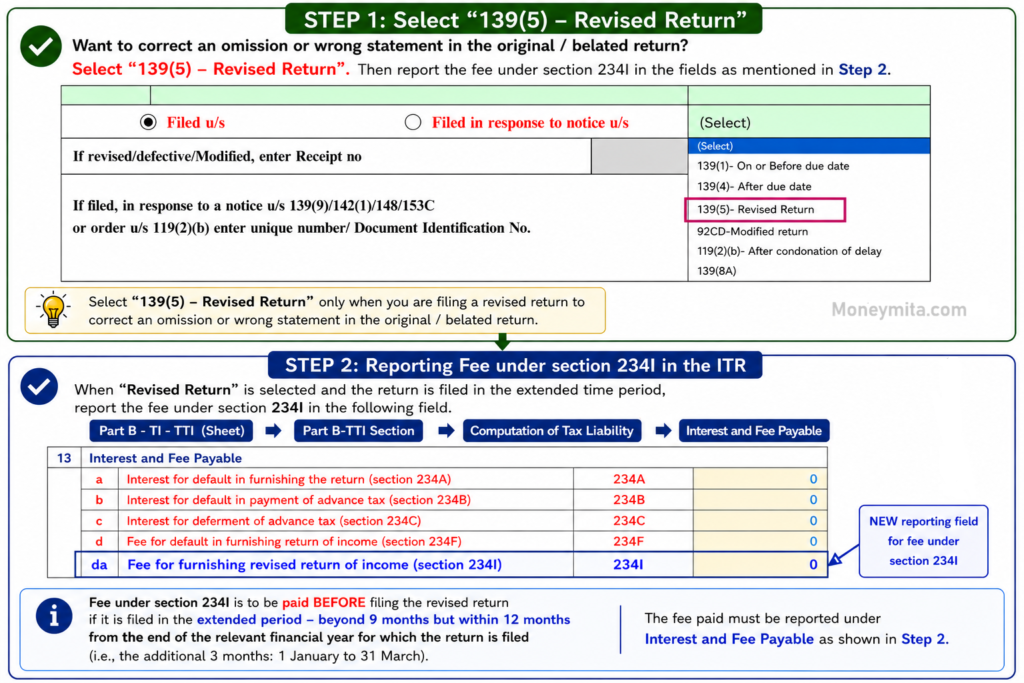
- Part A – General (Information) 👉Filed u/s → Section 139(5) – Revised Return.
- Part B – TI – TTI 👉Section: Part B-TTI➡️Computation of Tax liability➡️Interest and fee payable➡️Fee for furnishing revised return of income (Section 234I).
What’s changed?
A revised return is filed to correct an omission or wrong statement in an original or belated return. Earlier, a revised return could be filed up to:
- Three months before the end of the relevant assessment year [i.e., nine (9) months from the end of the relevant financial year]; or
- Completion of the assessment, whichever was earlier.
The Finance Act, 2026 introduced two important changes:
- The time limit has been extended from 9 months to 12 months from the end of the relevant financial year, giving taxpayers an additional three (3) months to revise their return.
- A new fee under section 234I has also been introduced. It must be paid before filing a revised return during this extended three-month period. Accordingly, the ITR forms for AY 2026-27 include a new row for reporting the fee payable under section 234I.
| PARTICULARS – TOTAL TAXABLE INCOME | FEES UNDER SECTION 234I -IT ACT 1961 |
|---|---|
| Up to Rupees Five Lakhs [<= ₹5,00,000/-] | Rupees One Thousand [₹1,000/-] |
| Above Rupees Five Lakhs [> ₹5,00,000/-] | Rupees Five Thousand [₹5,000/-] |
Example: Mr. Arup Sinha filed his original ITR-2 on 15th June 2026 for AY 2026-27 with a total income of ₹13,50,230. He later filed a revised return on 28 July 2026. Is he required to pay the fee under section 234I?
Ans. ❌No.
Since the revised return was filed before 31 December 2026 (i.e., within the original nine-month period), no fee under section 234I is payable. The fee becomes applicable only if the revised return is filed during the extended period, i.e., from 1 January 2027 to 31 March 2027.
3. Representative Assessee: Reporting Requirements Rationalized
🔎In Which ITR: ITR 1 to 7.
🔎Schedule Reference in the ITR: Part A – General (Information)👉Whether the return is being filed by a Representative Assessee?
What’s changed?
A Representative Assessee (RA) is a person who files an income tax return on behalf of another person in circumstances specified under the Income-tax Act. Representative assessees generally include guardians, trustees, agents of non-residents and certain other specified persons.
The ITR forms for AY 2026-27 have simplified the information required from a representative assessee.
| PARTICULARS | AY 2025-2026 (OLD) | AY 2026-2027 (NEW) |
|---|---|---|
| Details of Representative Assessee | 1. Name 2. Capacity. 3. Address. 4. PAN. 5. AADHAAR. | 1. Name 2. E-Mail ID. 3. Contact Number. |
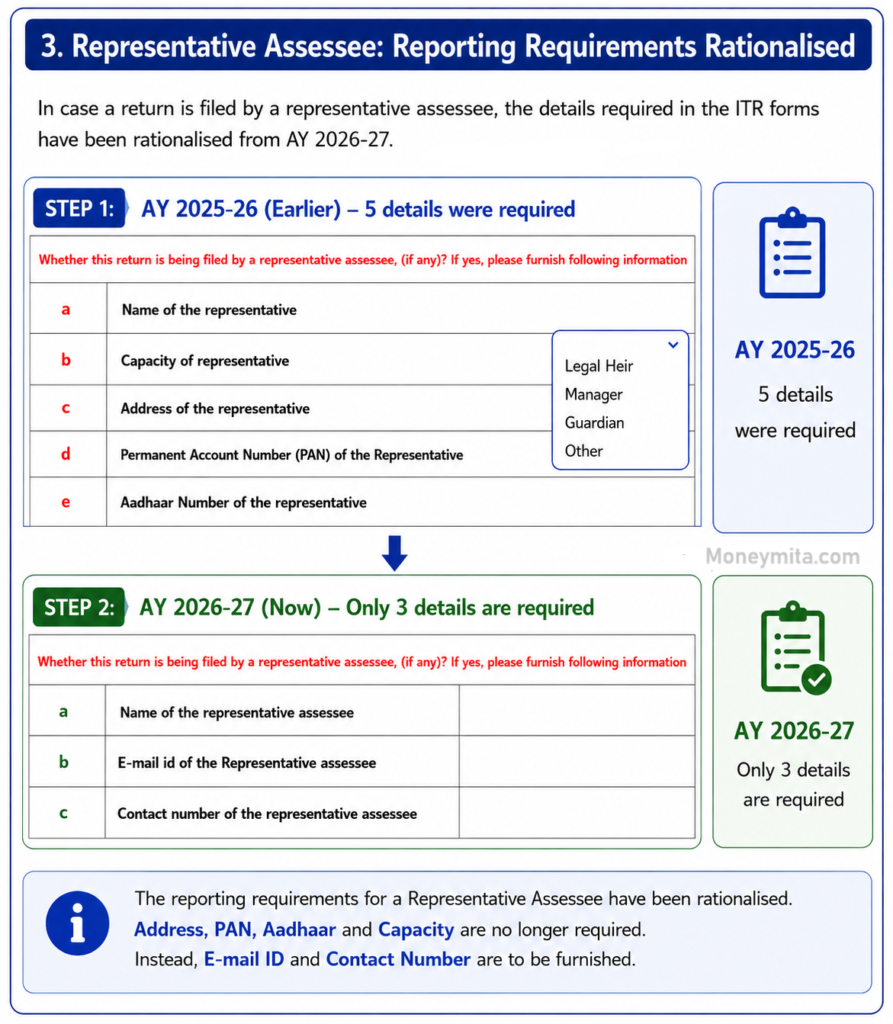
Example: A guardian filing an ITR on behalf of a minor child as a representative assessee is now required to furnish only the name, e-mail ID and contact number, instead of the capacity, address, PAN and Aadhaar.
ITR 1 to 6 AY 2026-27: New Changes in ITR Forms
Schedule 80G: Enhanced Reporting for Donation Payments
🔎In Which ITR: ITR 1 to 6
🔎Schedule Reference in the ITR: Schedule 80G
Section 80G provides a deduction for eligible donations made to specified funds and institutions, subject to prescribed conditions. Such deduction is available only where:
- The recipient fund or institution has been approved by the Principal Commissioner or Commissioner.
- Furnishes the prescribed statement of donations.
- Issues the donation certificate, and complies with the other conditions specified under the Income-tax Act.
Deduction under Section 80G is generally available only under the Old Tax Regime. This deduction cannot be claimed by taxpayers who opt for the default New Tax Regime.
What’s changed?
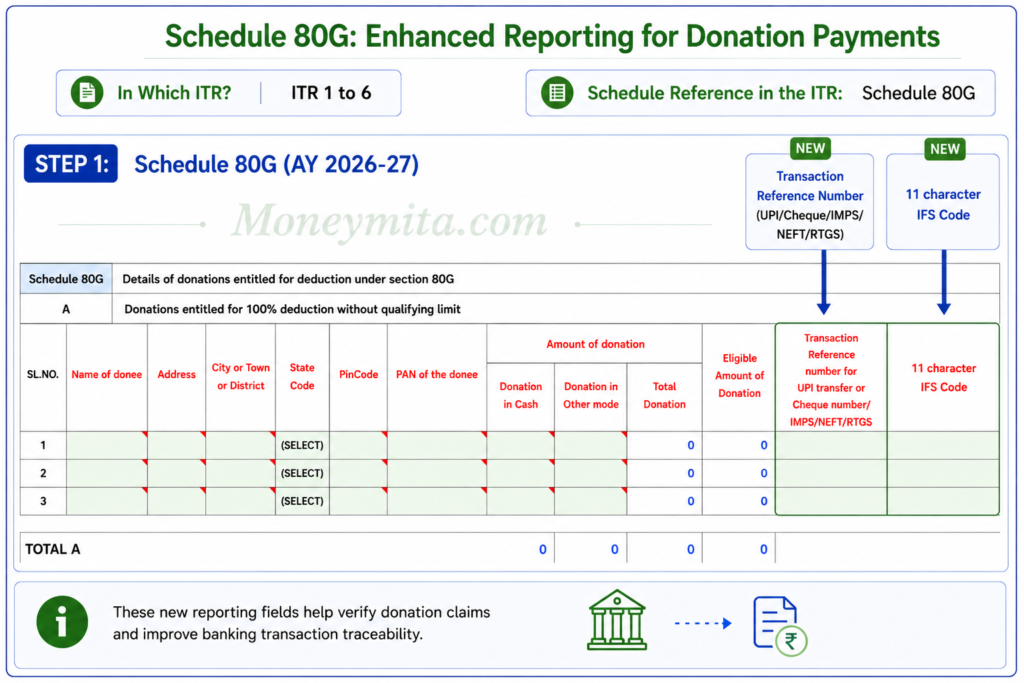
The ITR forms for AY 2026-27 require taxpayers claiming deduction under Section 80G to furnish two additional details for every eligible donation:
- Transaction Reference Number (for UPI/Cheque/IMPS/NEFT/RTGS).
- 11-character IFS Code of the bank through which the donation was made.
These additional disclosures strengthen the verification of donation claims and improve the traceability of banking transactions.
| PARTICULARS | AY 2025-2026 (OLD) | AY 2026-2027 (NEW) |
|---|---|---|
| 1. Transaction Reference Number | Not Required. | Required. |
| 2. Bank IFS Code | Not Required. | Required. |
Example: Mr. X, a resident in Alipore, Kolkata, W.B, donates ₹10,000/- to an institution approved under Section 80G through SBI-Alipore Branch Net banking. While claiming the deduction in the ITR for AY 2026-27, he must now furnish the UPI Transaction Reference Number [Say, SBIN 1234 5678 9934] and the 11-character IFS Code of the bank [say, SBIN 0 000 004] through which the payment was made.
ITR 1 to 5 AY 2026-27: New Changes In ITR Forms
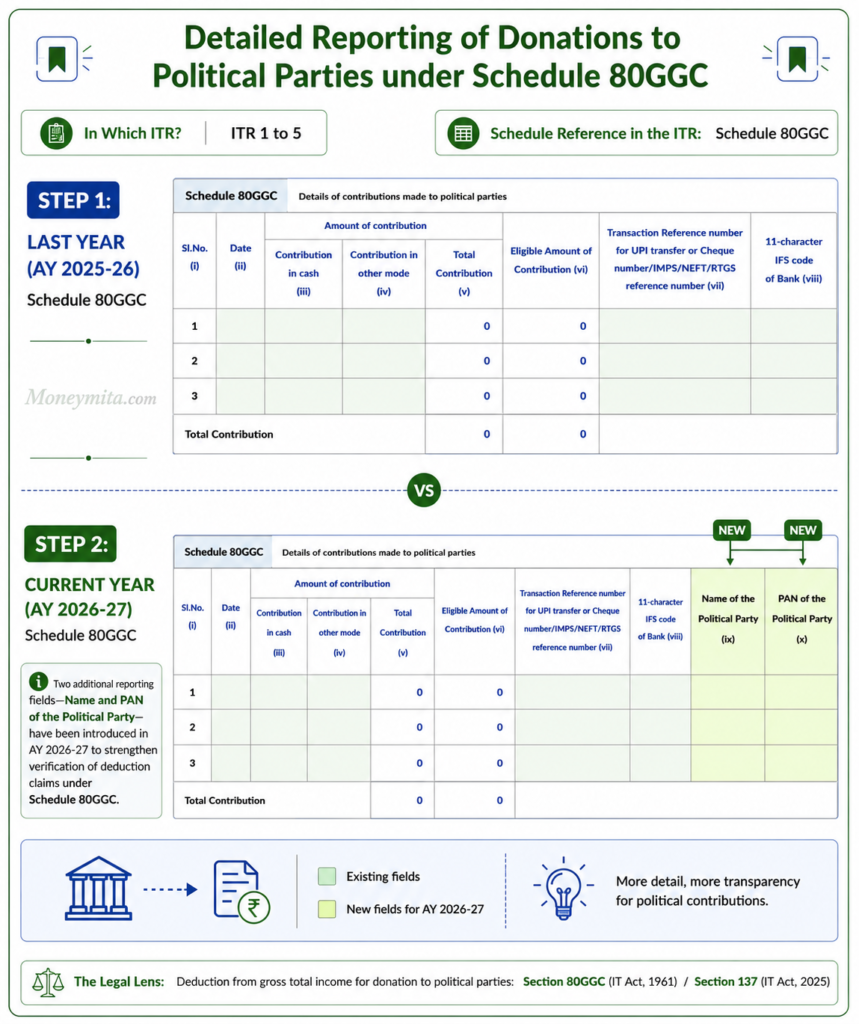
Detailed Reporting of Donations to Political Parties under Schedule 80GGC
🔎In Which ITR: ITR 1 to 5.
🔎Schedule Reference in the ITR: Schedule 80GGC.
Section 80GGC provides a deduction for eligible contributions made to a political party registered under the Representation of the People Act, 1951, or to an Electoral Trust. However, this benefit is not available to:
1)A local authority and every artificial juridical person wholly or partly funded by the Government; and
2)An Indian company claiming deduction under Section 80GGB.
What’s changed?
The ITR Forms AY 2026-27 have expanded the disclosure requirements under Schedule 80GGC.
Earlier, taxpayers were required to furnish details of the amount of contribution, transaction reference number and the 11-character IFS Code for payments made through banking channels.
The revised ITR forms now require two additional details:
- Name of the Political Party.
- PAN of the Political Party.
This enhances transparency and enables better verification of deduction claims.
| PARTICULARS | AY 2025-2026 (OLD) | AY 2026-2027 (NEW) |
|---|---|---|
| Amount of contribution in cash | ☑️ | ☑️ |
| Amount of contribution through other modes (Cheque/UPI/IMPS/NEFT/RTGS) | ☑️ | ☑️ |
| Transaction Reference Number | ☑️ | ☑️ |
| 11-character IFS Code of Bank | ☑️ | ☑️ |
| Name of the Political Party | ❌Not Required. | ☑️ Required. |
| PAN of the Political Party | ❌Not Required. | ☑️ Required. |
FREQUENTLY ASKED QUESTIONS (FAQ)
Q1. How do AOP and BOI differ under the Income-tax Act, 1961?
Ans. An AOP (Association of Persons) is formed voluntarily by persons (individuals/ non-individuals) to earn income. A BOI (Body of Individuals) consists only of individuals and may arise by operation of law, such as co-heirs inheriting property.
Q2. What is a Business Trust?
Ans. A Business Trust is a pass-through investment vehicle governed by section 115UA of the Income-tax Act, 1961. Real Estate Investment Trusts (REITs) and Infrastructure Investment Trusts (InvITs) are Business Trusts.
Q3. What is an Investment Fund under 115UB of the Income Tax Act, 1961?
Ans. An Investment Fund pools money from multiple investors to invest in specified assets and mainly includes Alternative Investment Funds (AIFs). Unlike REITs and InvITs, AIFs are governed by section 115UB.
Q4. What does Section 92E of the Income-tax Act, 1961 deal with?
Ans. Section 92E applies where an assessee enters into specified international or specified domestic transactions with related parties.
Example: An Indian company purchasing goods from its foreign parent company is an international transaction that may be covered under section 92E.

I am a practicing Chartered Accountant, now venturing into content writing. Covering money matters—taxation, finance & financial news—presenting accurate, easy-to-understand insights, combining professional knowledge with a passion for educating readers on managing and understanding their finances better.