
Public Sector Undertakings (PSUs), also known as Public Sector Enterprises (PSEs), originated from India’s economic vision after Independence in 1947. Their growth reflects the government’s objective of building a self-reliant and socially balanced economy. Over time, PSUs have played a crucial role in industrial development, infrastructure creation, and national economic planning.
Definition of PSE
A Public Sector Enterprise (PSE) is a government-owned corporation established to carry out commercial and strategic activities.
These enterprises are fully or majority owned (at least 51%) by the Central or State Government and function under the administrative control of the concerned Ministry or Department.
PSUs contribute significantly to India’s GDP and support key sectors such as energy, banking, defence, and manufacturing. Their objectives include infrastructure development, public welfare, employment generation, and maintaining government control over critical industries.
Examples of major PSUs include ONGC, BHEL, and State Bank of India.
History Behind The Formation Of PSUs
The evolution of Public Sector Undertakings (PSUs) in India reflects the country’s economic and political transformation. From limited government enterprises during British rule to a strong public sector-led development model after Independence, PSUs were created to support industrial growth, reduce inequalities, and strengthen national self-reliance.
Pre-Independence Era
During British rule, industrial development in India was minimal and primarily served colonial interests. Only a few government-owned enterprises existed, mainly in strategic and utility sectors.
Some early public enterprises included Railways, Post and Telegraph, Port Trusts, Ordnance Factories, and All India Radio. These institutions were established to support administration and defense rather than promote national industrial development.
Post-Independence Era
After Independence, India faced major economic challenges such as inflation, unemployment, income inequality, regional imbalance, and lack of infrastructure. The economy was largely agrarian with weak industrial capacity, low savings, and limited investment.
There were contrasting views: labour leaders demanded nationalisation, while industrialists supported free enterprise. To resolve this confusion, the government introduced a formal Industrial Policy to define the role of the public and private sectors.
Industrial Policy refers to government actions aimed at shaping the ownership, structure, and performance of industries through regulation, financial support, and planning. The Government of India issued several Industrial Policy Resolutions (IPRs) in 1948, 1956, 1973, 1977, 1980, and 1991. Among them, IPR 1956 and IPR 1991 were the most influential.
Industrial Policy Resolution, 1956
The Industrial Policy Resolution (IPR) 1956, regarded as a foundational economic framework for India, categorised industries into three segments.
- Schedule A: 17 industries exclusively reserved for the public sector, such as arms and ammunition, iron and steel.
- Schedule B: 12 industries in which both the public and private sectors could operate, including transport and mining.
- Schedule C: Remaining industries open to private enterprise, with special focus on cottage and small-scale industries for employment generation.
This policy laid the foundation for the Second Five-Year Plan, emphasising industrialisation, infrastructure development, and social welfare.
New Industrial Policy, 1991
Popularly known as the Liberalised Industrial Policy, 1991, this policy aimed to remove excessive controls and promote efficiency and competition.
KEY FEATURES:
- Abolition of industrial licensing for most industries (except 18 strategic sectors).
- Allowing foreign direct investment up to 51% in selected industries.
- Encouraging exports and liberalising imports.
- Establishment of BIFR (Board of Industrial and Financial Reconstruction) to monitor financially weak PSUs.
This policy marked a shift from a controlled economy to a liberalised and market-oriented framework while redefining the role of PSUs.
Types Of PSU In India
Public Sector Undertakings (PSUs) in India are classified based on ownership structure and the degree of financial and operational autonomy. These classifications help in understanding how different PSUs function and how much independence they have in decision-making.
The major classifications are:
- Based on Ownership.
- Based on the national importance and security relevance of their operations in the sectors in which they operate.
- Based on Financial Autonomy.
Based on Ownership
Under this classification, PSUs are grouped according to whether they are owned by the Central Government or State Governments.
Based on Ownership, PSUs are of three main types:
- Central Public Sector Undertakings (CPSUs).
- State Public Sector Undertakings (SPSUs).
- Public Sector Banks (PSBs).
Central Public Sector Undertakings (CPSUs)
Central PSUs are enterprises in which the Central Government, either directly or through other CPSUs, holds at least 51% ownership. The government aims to transform CPSEs into autonomous, board-driven enterprises.
Evolution and Role of the Department of Public Enterprises (DPE)
In May 1990, the Bureau of Public Enterprises (BPE) was upgraded to the Department of Public Enterprises (DPE), which now functions under the Ministry of Heavy Industries and Public Enterprises. The DPE acts as the nodal agency for all Central Public Sector Enterprises (CPSEs). Its key responsibilities include:
- Framing policies and guidelines for CPSEs.
- Monitoring and evaluating performance.
- Promoting efficiency and better governance.
- Supporting reforms in the functioning of PSUs.
The DPE makes an annual survey on the performance of CPSEs and places the “PE Survey Report” before both houses of parliament around December of the next financial year, for the previous financial year.
PE Survey Report of FY 2023-24
As per the PE Survey Report of FY 2023-24, placed in December 2024, the notable observations as on March 31, 2024, are:
- Total number of CPU = 448.
- Operating CPU = 272.
- Profit-Generating Operating CPU = 212.
| INDICATOR | FY 2022 – 2023 [In ₹] | FY 2023 – 2024 [In ₹] | % CHANGE |
| Overall Net Profit Of Operating CPSEs | 2.18 [Lakh Crore] | 3.22 [Lakh Crore] | 47.42 |
| Contribution to Central Exchequer [Of All CPSEs] | 4.58 [Lakh Crore] | 4.85 [Lakh Crore] | 5.96 |
Category Of CPSEs:
Public sector enterprises are categorised into 4 schedules, namely A, B, C & D.
As per the Annual Report of DPE, FY 2024-2025, there are
- 77 Schedule ‘A’ companies [Ex: Airport Authority Of India].
- 65 Schedule ‘B’ companies [Ex: Andrew Yule & Company Limited].
- 46 Schedule ‘C’ companies [Ex: The Jute Corporation of India Limited].
- 6 Schedule ‘D’ companies [Ex: Orissa Drugs & Chemicals Limited].
The Classification is based on:
- Quantitative Factors: Investment, capital employed, net sales, profit before tax, number of employees and units, etc.
- Qualitative Factors: National importance, level of technology, etc.
State Public Sector Undertakings (SPSUs)
State PSUs are enterprises in which a State Government holds at least 51% ownership. These undertakings operate at the regional level and focus on state-specific development goals such as power generation, transport, irrigation, and local industries.
Public Sector Banks (PSBs)
Public Sector Banks are government-owned banks in which the Central Government or State Governments hold more than 50% equity through their respective Ministries of Finance.
These banks are listed on stock exchanges and primarily aim to achieve social welfare objectives such as:
- Financial inclusion.
- Priority sector lending.
- Support for agriculture and small businesses.
- Economic development in rural and semi-urban areas.
SOURCE:PSB IN INDIA
Based on the Importance of Sectors
Both CPSUs and SPSUs are further classified into:
- Strategic Sector PSUs: Enterprises operating in critical sectors such as defence, atomic energy, space, and the railways are essential for national security and sovereignty.
- Non-Strategic Sector PSUs: Enterprises engaged in commercial and industrial activities such as steel, petroleum, power, and telecommunications.
Based on Financial Autonomy
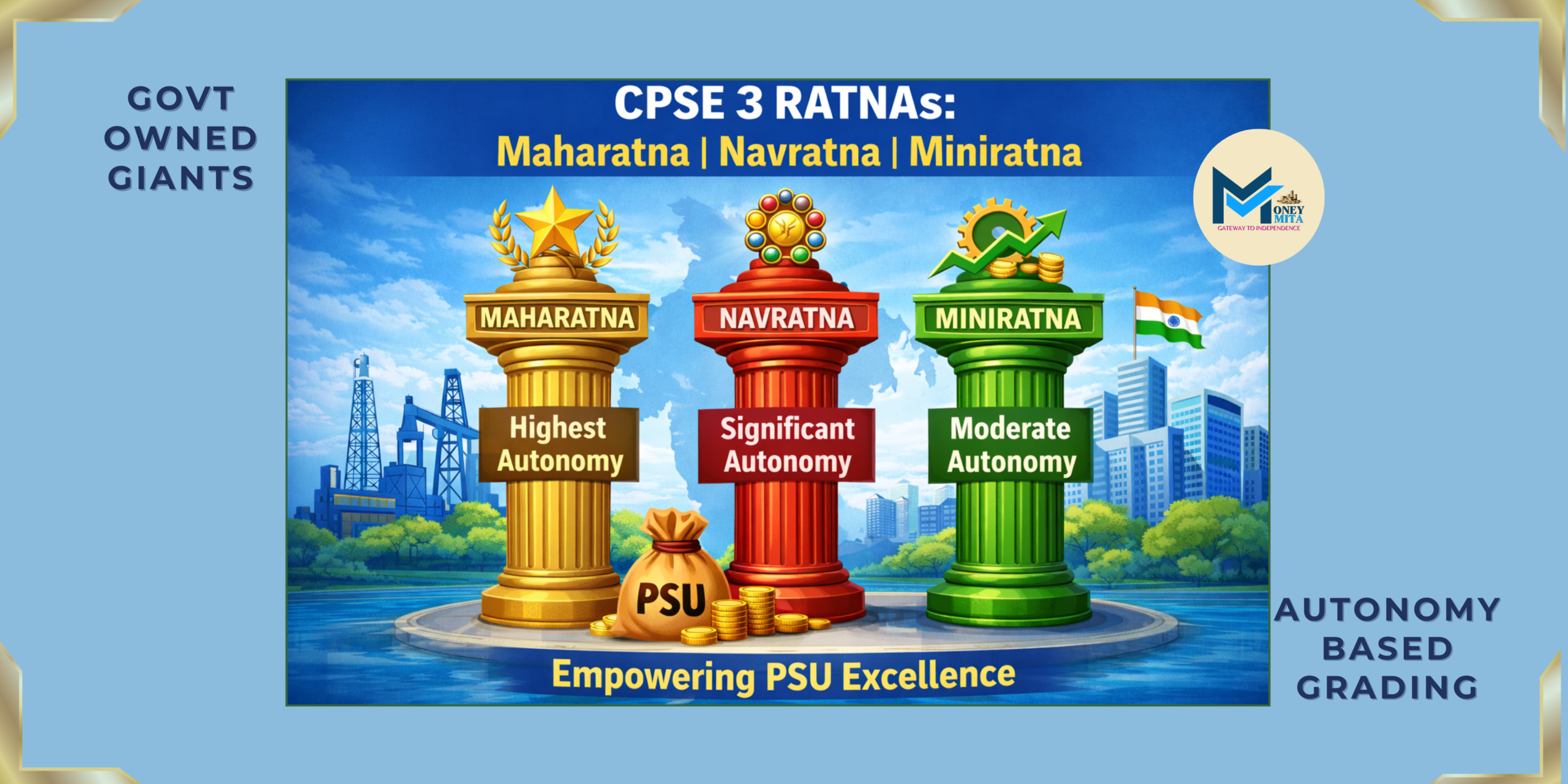
Public Sector Undertakings are classified into Maharatna, Navratna, and Miniratna based on their financial strength, operational performance, and decision-making autonomy. The Government of India grants this classification through the Department of Public Enterprises (DPE).
As per the DPE’s Annual Report 2024–25, the number of CPSEs under each category was:
- Maharatna: 14.
- Navratna: 24.
- Miniratna Category I: 51, Category II: 11.
These numbers are not fixed and may change over time due to the addition or removal of companies based on eligibility criteria.
Recent updates:
- HAL was upgraded to Maharatna status on 12 October 2024 (earlier Navratna since 2007).
- Nine (9) CPSEs were added to the Navratna category during FY2024–25.
- CEL (Central Electronics Limited) was added to the Miniratna Category-I on 26 June 2024.
This Ratna classification reflects the level of financial independence and strategic importance of CPSEs in India’s economy.
Comparison Between Maharatna, Navratna and Miniratna
| BASIS | MAHARATNA | NAVRATNA | MINIRATNA |
| Meaning | The highest status is given to top-performing CPSEs. | Status for financially strong CPSEs. | Status for consistently profitable CPSEs. |
| Purpose | Enable large investments and global expansion. | Support strategic growth and competitiveness. | Provide limited financial autonomy. |
| Eligibility Level | Must be Navratna + strict financial criteria. | Must be a Miniratna and composite performance score ≥ 60. | Profit in the last 3 years + positive net worth. |
Financial Strength Required | 1)Avg. turnover >₹25,000/- crore. 2)Net worth >₹15,000/- crore. 3)PAT >₹5,000/- crore (3 yrs avg). | No fixed turnover limit (score-based). | Cat-I: Pre-tax profit ≥ ₹30 crore in one of the last 3 yrs clubbed with positive net worth. |
| Investment Power (CAPEX) | No monetary ceiling. | Per Project Up to ₹1,000/- crore or 15% of net worth. | Cat-I: up to ₹500/- crore. Cat-II: up to ₹250/- crore. |
| Level of Autonomy | Very high. | High. | Moderate. |
| Focus Area | Global expansion & mega projects. | Strategic domestic growth. | Operational efficiency. |
| Strategic Importance | National & international. | National. | Operational. |
| Examples | ONGC, NTPC, IOCL, HAL. | BEL, HPCL, PFC. | RITES, IRCTC, CEL. |
Similarities among all 3 RATNAs
The following features are common among all Maharatna, Navratna and Miniratna companies.
- The objective is to improve efficiency, competitiveness, and autonomy.
- Applicable only to Central Public Sector Enterprises (CPSEs).
- The Government of India grants status through DPE.
- Status is reviewed periodically.
- Can be upgraded or downgraded based on performance.
Frequently Asked Questions (FAQ)
Q1. Can a CPSE lose its Ratna status granted once?
Ans. YES. Ratna status is reviewed periodically, and a CPSE can be downgraded if it fails to meet performance or financial criteria.
Q2. Does Ratna’s status change the ownership of a CPSE?
Ans. No. Ratna status only increases decision-making and investment powers. The ownership continues to remain with the Government of India.
Q3. Do Strategic Sector PSUs automatically become Maharatna or Navratna?
Ans. No. Strategic importance alone does not guarantee Ratna status. CPSEs must satisfy financial and performance benchmarks prescribed by the Department of Public Enterprises (DPE).
Q4. What stands for ONGC, NTPC, IOCL, HA.L, BEL, HPCL, PFC., RITES, IRCTC, CEL?
Ans. ONGC – Oil and Natural Gas Corporation, NTPC – National Thermal Power Corporation, IOCL – Indian Oil Corporation Limited, HAL – Hindustan Aeronautics Limited, BEL – Bharat Electronics Limited, HPCL – Hindustan Petroleum Corporation Limited, PFC – Power Finance Corporation, RITES – Rail India Technical and Economic Service, IRCTC – Indian Railway Catering and Tourism Corporation, CEL – Central Electronics Limited.
Concluding Note
The Ratna classification system strengthens India’s CPSE framework by granting autonomy based on performance and financial strength. Maharatna, Navratna, and Miniratna status encourage competitiveness, efficiency, and strategic growth. Together, they play a vital role in supporting India’s economic development and public sector reforms.

I am a practicing Chartered Accountant, now venturing into content writing. Covering money matters—taxation, finance & financial news—presenting accurate, easy-to-understand insights, combining professional knowledge with a passion for educating readers on managing and understanding their finances better.