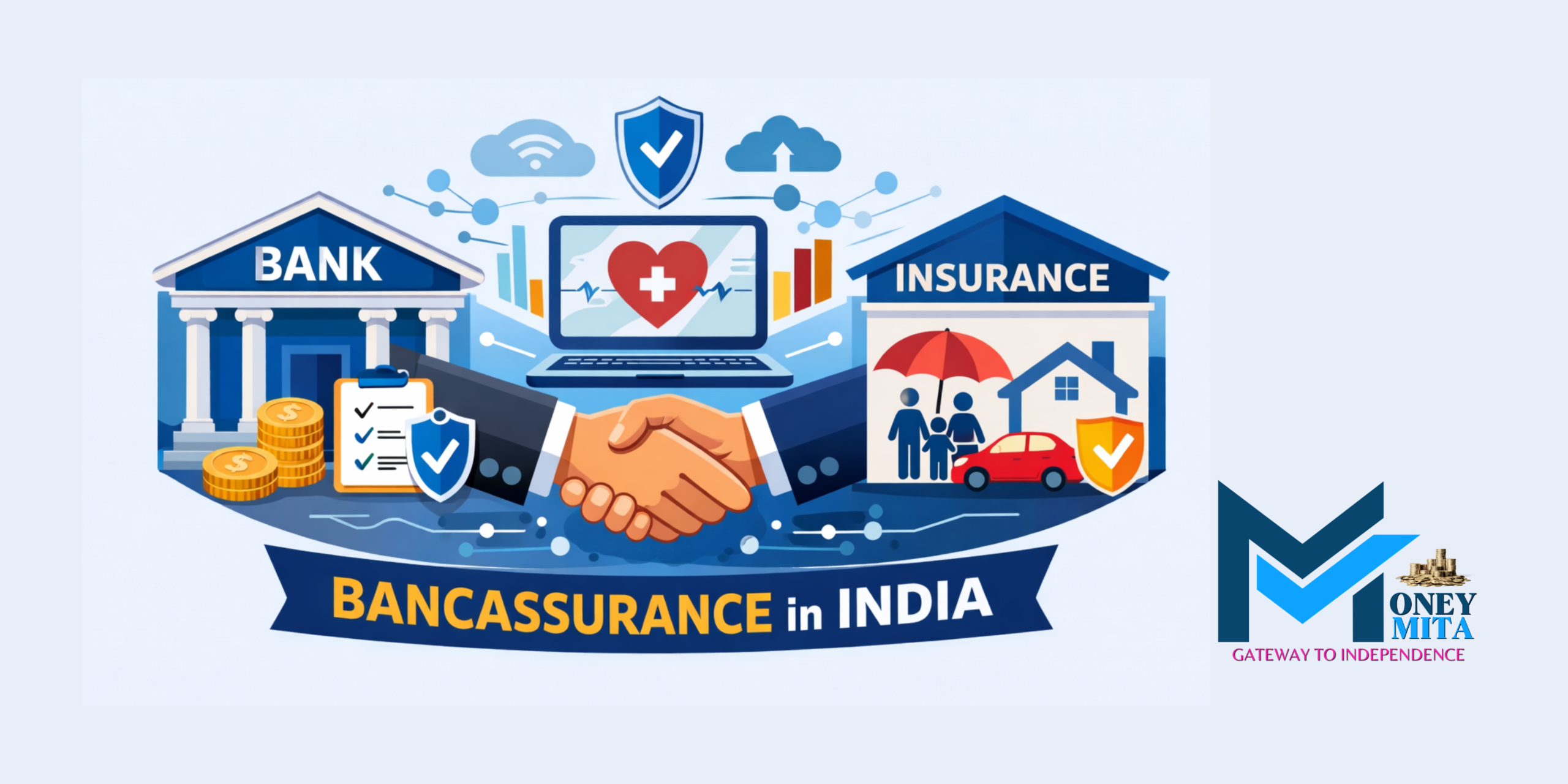
In India’s rapidly growing financial services sector, “Bancassurance-in-India” has become an important distribution channel connecting banks and insurance companies. It allows customers to purchase insurance products directly through their banks, making financial protection more accessible and convenient.
With increasing trust in banking institutions and rising awareness about financial security, bancassurance has expanded significantly across the country. Today, many leading Indian banks partner with insurance companies to offer life, health, and general insurance products under one roof.
Imagine visiting your bank branch for routine banking work and also securing insurance coverage for your family at the same place. This integrated approach explains how bancassurance in India is simplifying access to insurance for millions of customers.
What is Bancassurance in India?
The relationship between the banking and insurance sectors has evolved significantly over the past decade. In today’s financial ecosystem, bancassurance in India allows banks and insurance companies to collaborate and offer integrated financial solutions to customers.
Bancassurance is a business model in which banks and insurers combine their strengths to distribute insurance products through banking channels. Banks leverage their wide branch networks, digital platforms, and long-lasting customer relationships to sell insurance products that are designed and underwritten by insurance companies. Through this model, customers can access banking and insurance services under one roof, making financial planning more convenient and efficient.
THE EVOLUTION OF BANCASSURANCE IN INDIA
The concept of bancassurance originated in France during the 1980s and later expanded across Europe and Asia. Bancassurance in India formally began in 2000 when the government, based on recommendations of the Insurance Regulatory and Development Authority (IRDA), permitted banks to undertake insurance distribution under Section 6(1)(o) of the Banking Regulation Act, 1949.
However, banks were required to obtain prior approval from the Reserve Bank of India (RBI). This ensured that the growth of bancassurance in India remained regulated and customer-centric.
Current Regulatory Framework
Today, bancassurance in India operates under the joint supervision of:
- Reserve Bank Of India (RBI).
- Insurance Regulatory and Development Authority of India (IRDAI).
Mandatory Requirements
- Bank staff must undergo training and certification before selling insurance.
- Full transparency in policy details, premiums, and charges.
- Strict compliance with consumer protection norms.
- Proper suitability assessment to prevent mis-selling.
Partnership Structure
Banks may act as Corporate Agents or Insurance Brokers. As corporate agents, banks can partner with:
- One life insurance company.
- One general (non-life) insurance company.
- One standalone health insurance company.
- Specialised insurers such as ECGC or AIC (with approval).
Bancassurance: Meaning
Bancassurance is a strategic partnership between banks and insurance companies where insurance products are distributed through banking channels.
The term “bancassurance” is a combination of two words — Bank and Assurance — meaning banking services combined with insurance protection.
Traditionally, insurance products were sold through individual agents, who still account for a major share of retail insurance distribution. However, after regulatory changes in 2000, bancassurance in India gained significant momentum as banks began offering insurance products directly to their customers.
Instead of approaching separate institutions for banking and insurance needs, customers can now access both services at their trusted bank branch or digital banking platform.
The Three Key Participants in Bancassurance:
- Banks – Act as the distribution channel.
- Insurance Companies – Design and underwrite insurance policies.
- Customers – Gain convenient access to insurance through their bank.
This structure creates a mutually beneficial ecosystem for all stakeholders.
How Bancassurance Works in India?
Understanding how bancassurance works in India requires examining the coordinated roles of banks, insurance companies, and customers. In this model, banks act as distribution partners, insurance companies provide product and risk expertise, and customers benefit from integrated financial services. The structure ensures that insurance products are delivered efficiently while maintaining regulatory compliance and customer protection standards.
Role of Banks in Selling Insurance
Banks act as the customer-facing distribution channel in bancassurance in India. Their primary role is to connect customers with suitable insurance products using their established banking infrastructure.
Banks leverage:
- Extensive branch networks.
- Digital banking platforms.
- Existing customer relationships.
- Customer financial data (within regulatory limits).
Through these advantages, banks identify customer needs, recommend appropriate insurance products, and assist with policy applications and premium payments. Unlike traditional insurance agents, banks integrate insurance offerings into routine banking interactions such as account opening, loan processing, or investment discussions. This enables cross-selling and enhances overall financial planning for customers.
Banks earn Commissions or Referral Income from insurance sales, creating a diversified revenue stream beyond interest-based earnings. This model strengthens profitability while maintaining regulatory compliance.
Role of Insurance Companies in Selling Insurance
Insurance companies contribute product expertise, underwriting capabilities, and risk management strength to the bancassurance partnership. Their key responsibilities include:
- Designing insurance products suited to the bank’s customer base.
- Training bank staff on product features and compliance requirements.
- Handling policy issuance and administration.
- Managing claims processing and settlement.
- Providing marketing and promotional support.
Through bancassurance in India, insurers gain access to a large and trusted customer base without investing heavily in building an independent distribution infrastructure.
Process of Bancassurance for Customers
The customer journey in bancassurance in India is designed to be simple and convenient – Let’s have a quick look.
- Discovery: Customers learn about insurance products during branch visits or via digital banking platforms.
- Needs Assessment: Bank representatives assess the customer’s financial profile and insurance requirements.
- Product Selection: Suitable products are recommended from the partner insurer’s portfolio.
- Application: Applications are completed with minimal paperwork, often digitally.
- Payment: Premium payments are facilitated directly through the customer’s bank account.
- Policy Issuance: Policies are issued promptly, with some insurers offering same-day issuance.
- Servicing: Ongoing service and support are provided through both bank and insurer channels.
Models Of Bancassurance in India
Bancassurance in India operates through different structural models that define how banks and insurance companies collaborate. These models determine the level of involvement of banks, revenue-sharing mechanisms, regulatory responsibilities, and customer interaction processes.
The three primary models used in bancassurance in India are:
- Corporate agency Model.
- Broker Model.
- Referral Model.
Each model varies in terms of control, compliance requirements, and revenue potential.
Corporate Agency Model (CAM) – Features, Advantages & Disadvantages
Under the corporate agency model, a bank is officially appointed as an authorised corporate agent of an insurance company. The bank distributes the insurer’s products and earns commission on policies sold. This remains the dominant structure in bancassurance in India.
The insurer provides product training and compliance guidance to bank staff, enabling them to offer insurance solutions directly to customers.
| FEATURES | ADVANTAGES | DISADVANTAGES |
| 1. The bank operates as a licensed corporate agent. | 1. Bank retains stronger control over the customer interaction process. | 1. Ongoing staff training and certification are required. |
| 2. Insurance products are sold by trained bank employees to bank’s customers. | 2. Commission income is generally higher than referral-based arrangements. | 2. Strict regulatory compliance must be maintained. |
| 3. Revenue is generated through commission on policy sales. | 3. Existing customer relationships improve trust and sales conversion. | 3. Risk of reputational damage in cases of mis-selling of the product. |
| 4. Sales activities are integrated into regular banking operations. | 4. Insurance products can be cross-sold alongside loans and deposit products. | 4. Additional responsibilities may increase operational pressure on bank employees. |
To know about the Corporate Agency Arrangement, please read the Blog post “4 KEY INSURANCE NEWS: TATA AIA, LIC, COVRZY AND ICICI”.
Broker Model (BM) – Features, Advantages & Disadvantages
| FEATURES | ADVANTAGES | DISADVANTAGES |
| 1. A bank can partner with multiple insurers. | 1. Greater product choice for customers. | 1. Higher regulatory and compliance requirements. |
| 2. Customers receive broader product options. | 2. Competitive pricing due to multiple insurer options. | 2. Increased documentation and reporting obligations. |
| 3. The bank may provide comparative product advice. | 3. Ability to offer unbiased product comparison. | 3. Operational complexity. |
| 4. Operates under broker licensing norms. | 4. Stronger customer trust through advisory approach. | 4. Potential conflict of interest management challenges. |
Referral Model (RM) – Features, Advantages & Disadvantages
| FEATURES | ADVANTAGES | DISADVANTAGES |
| 1. Insurance company executives handle sales. | 1. Limited training required for bank employees. | 1. Lower income potential compared to other models. |
| 2. Bank earns referral fees for leads generated. | 2. Reduced regulatory exposure. | 2. Less control over customer experience. |
| 3. Minimal involvement of bank staff. | 3. Easy to implement and manage. | 3. Limited integration with core banking operations. |
| 4. Insurance personnel operate from bank premises. | 4. Low operational cost for banks. | 4. Weak cross-selling capability. |
Benefits of Bancassurance
The growth of bancassurance in India has created measurable advantages for all participants in the financial ecosystem. Unlike traditional insurance distribution channels, bancassurance generates value simultaneously for banks, insurance companies, and customers. By combining infrastructure, trust, and product expertise, this model strengthens financial inclusion while improving operational efficiency.
Benefits for Banks
For banks, bancassurance serves as an important strategy to diversify revenue and deepen customer engagement.
- Additional Revenue Stream: Banks earn commissions and referral fees from insurance sales, creating non-interest income beyond traditional lending and deposit activities.
- Fee-Based Income Growth: In an environment of compressed interest margins, bancassurance helps increase stable fee-based income.
- Product Diversification: Insurance offerings expand the bank’s financial product portfolio, enabling it to provide comprehensive financial solutions.
- Enhanced Customer Relationships: By becoming a one-stop financial service provider, banks improve customer retention and long-term engagement.
- Better Asset Utilisation: Existing branch infrastructure, digital platforms, and customer databases are used more efficiently without significant additional investment.
- Competitive Differentiation: Banks offering integrated banking and insurance services gain an advantage over competitors limited to traditional banking functions.
Benefits for Insurance Companies
For insurers, bancassurance in India provides an efficient and scalable distribution model.
- Access to Large Customer Base: Banks provide immediate access to millions of existing and verified customers.
- Cost-Effective Distribution: Distribution costs are significantly lower compared to maintaining large agent networks.
- Rapid Market Penetration: Insurance companies can expand quickly through extensive bank branch networks across urban and rural areas.
- Trust Transfer Effect: Customers’ existing trust in banks enhances credibility and increases insurance acceptance.
- Wider Geographic Reach: Banks enable insurers to access semi-urban and rural markets where building independent distribution would be expensive.
- Digital Integration Advantage: Insurers benefit from banks’ digital infrastructure, improving policy issuance and premium collection efficiency.
Benefits for Customers
Customers are the ultimate beneficiaries of bancassurance in India, as it simplifies access to financial protection.
- Convenience: Customers can handle both their banking and insurance needs at the same institution, without visiting separate providers.
- Time Efficiency: There is no need to approach multiple institutions separately for insurance coverage.
- Trusted Distribution Channel: Insurance products are purchased through familiar and established banking institutions.
- Integrated Financial Planning: Bank representatives can align insurance products with the customer’s savings, loans, and investment profile.
- Easy Premium Payments: Premiums are conveniently debited from existing bank accounts.
- Faster Processing: Digital integration enables quicker application processing and policy issuance.
- Customised Solutions: Insurance recommendations can be tailored based on the customer’s financial data and requirements.
Examples of Bancassurance in India
The practical impact of bancassurance in India can be better understood through examples across different insurance segments — life, general, and health insurance. The partnership alliance demonstrate how trust, scale, and technology combine to create powerful insurance distribution ecosystems.
Below are three prominent examples of bancassurance in India that illustrate different dimensions of this model.
Bancassurance Product: Life Insurance
Equitas Small Finance Bank (SFB) has entered into bancassurance partnerships to distribute life insurance products through its branch network. In February, the bank announced a tie-up to offer with Bharti AXA Life Insurance, backed by Bharti Enterprise and France’s AXA.
Under this arrangement:
- Bharti AXA will provide its life insurance products, including protection, savings and retirement plans, to banks’ customers.
- Both Physical and digital channels will be used to reach to customers.
Bancassurance Product: General Insurance
HDFC Bank distributes general insurance products through its partnership with HDFC ERGO General Insurance.
Products commonly offered include:
- Motor insurance.
- Home insurance.
- Travel insurance.
- Personal accident policies.
These products are often integrated with banking services such as car loans and home loans for customer convenience.
Bancassurance Product: Health Insurance (Standalone)
Star Health and Allied Insurance is a standalone health insurer focusing only on health insurance products. Under bancassurance in India, banks distribute Star Health policies through corporate agency partnerships.
Active banking partners include: Federal Bank, IDFC First Bank, UCO Bank, South Indian Bank, Standard Chartered Bank. This shows that bancassurance also covers standalone health insurance distribution.
Frequently Asked Questions(FAQ)
Q1. Is buying insurance through banks safe?
Ans. YES.
Banks distributing insurance must be registered with IRDAI as corporate agents or brokers. The insurance policy is issued and serviced by the insurance company; the bank only acts as a distribution channel.
Q2. Can I compare different insurance products at a bank?
Ans. It depends on the model. In the corporate agency or referral model, banks usually offer products from selected partner insurers. In the broker model, banks may provide options from multiple insurers.
Q3. What does ECGC stand for?
Ans. ECGC stands for Export Credit Guarantee Corporation of India Limited, a Government of India enterprise that provides credit risk insurance and related services to exporters.
Q4. What does AIC stand for?
Ans. AIC stands for Agriculture Insurance Company of India Limited. It provides crop and agricultural insurance in India.
The shareholding structure of AIC is: 1) General Insurance Corporation of India (GIC Re) – 35%, 2) NABARD (National Bank for Agriculture and Rural Development) holds a 30% stake, 3) 35% collectively held (8.75% each) by:
- United India Insurance Company Limited.
- National Insurance Company Limited.
- The Oriental Insurance Company Limited.
- The New India Assurance Company Limited.
This ownership structure reflects a strong public-sector backing in India’s agricultural insurance ecosystem.
Concluding Note
Bancassurance has transformed insurance distribution in India by combining banking reach with insurance expertise. It creates value for banks, insurers, and customers through integrated financial services.
With ongoing digital adoption and regulatory oversight, bancassurance is expected to play a significant role in expanding insurance access and strengthening financial inclusion across the country.

I am a practicing Chartered Accountant, now venturing into content writing. Covering money matters—taxation, finance & financial news—presenting accurate, easy-to-understand insights, combining professional knowledge with a passion for educating readers on managing and understanding their finances better.